T. Bailey Asset Management Limited do not provide advice to private individuals.

The information contained on this website is intended to provide information about our products and services and is not intended as investment advice. It is important that you do not rely upon its content to make investment decisions without seeking independent advice.

This website is intended for United Kingdom professional investors and advisers only. Please ensure you read the important legal information.

1 December 2025: Weekly Update – UK Budget, Fiscal Headroom and Low Growth

Weekly Update
Economic Outlook

The UK Autumn Budget reassured financial markets in the short term, though structural economic weaknesses and political volatility remained unresolved

Speculation around the UK Budget - and the reaction to it - dominated the news this week, not least with the United States distracted by Thanksgiving. At heart, this was a tax‑and‑spend Budget designed to steady the UK’s finances and reassure gilt investors by creating a modest cushion of fiscal headroom. That has helped to pull gilt yields marginally lower and ease immediate borrowing pressures. Yet it leaves the UK’s deeper structural problems largely untouched. The result is an economy still locked into a low‑growth rut, ill‑equipped to fund rising demands on public services, particularly from an ageing population. For all the rhetoric about being forward‑looking, the package does little to shift the underlying pattern of stagnation.
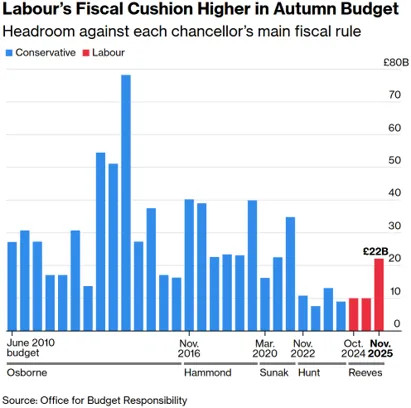
Fiscal headroom against each chancellor’s main fiscal rule

Picture2

Source: Bloomberg.

A defining feature of this Budget is its “buy now, pay later” approach. Many of the biggest tax‑raising measures are pushed into the later years of the forecast period, creating short‑term breathing space while shifting much of the real pain into the future. If growth were to pick up strongly, some of these measures might never fully bite; if it does not, the squeeze will land just as the government’s current mandate is drawing to a close. That may be enough to keep the Labour party broadly united for now, but the public mood is likely to be less forgiving. With local elections on the horizon, voters may well use the ballot box to register frustration at a settlement that offers little visible benefit today and depends heavily on hope about tomorrow. Political volatility therefore looks set to continue, even if the Budget has calmed markets for the moment.

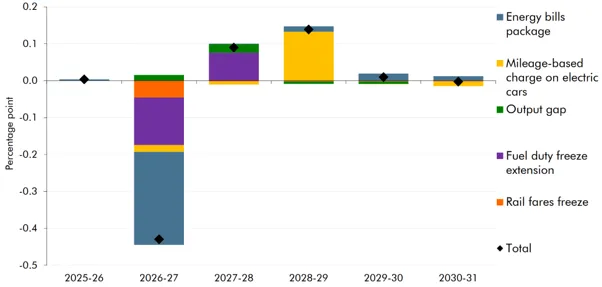
From an economic standpoint, back‑loading tax rises has one clear advantage: it helps to keep near‑term inflation pressures in check and gives the Bank of England more room to start cutting interest rates. That shift will be welcomed by households facing higher mortgage costs and by businesses looking to invest. Beyond this cyclical relief, however, there is disappointingly little in the Budget that actively lifts the UK’s growth potential. There is no coherent industrial strategy, and incentives to boost productivity, investment and innovation remain piecemeal.

Impact of Budget policies on CPI inflation

Picture3

Source: Office for Budget Responsibility, 26 November 2025.

For savers and investors, the picture is more nuanced. A more stable gilt market and the prospect of lower interest rates support asset prices, including UK shares, by easing financing conditions and lowering discount rates. But the lack of a convincing growth story continues to weigh on the outlook for domestically focused companies that depend on UK demand. Even so, UK equities as a whole still offer relatively low valuations and attractive dividend yields compared with many other developed markets facing similar or worse structural challenges. For long‑term investors, that combination of income and value keeps the UK market of interest.

Back to All Articles