T. Bailey Asset Management Limited do not provide advice to private individuals.

The information contained on this website is intended to provide information about our products and services and is not intended as investment advice. It is important that you do not rely upon its content to make investment decisions without seeking independent advice.

This website is intended for United Kingdom professional investors and advisers only. Please ensure you read the important legal information.

1 June 2026: Weekly Update – The Real Economy, AI Concentration and Water Infrastructure

Weekly Update
Economic Outlook

US equity markets continue to reach new highs, but gains remain concentrated in a narrow group of AI beneficiaries. Meanwhile, essential infrastructure businesses in water and waste continue to compound steadily despite receiving little investor attention.

The Real Economy

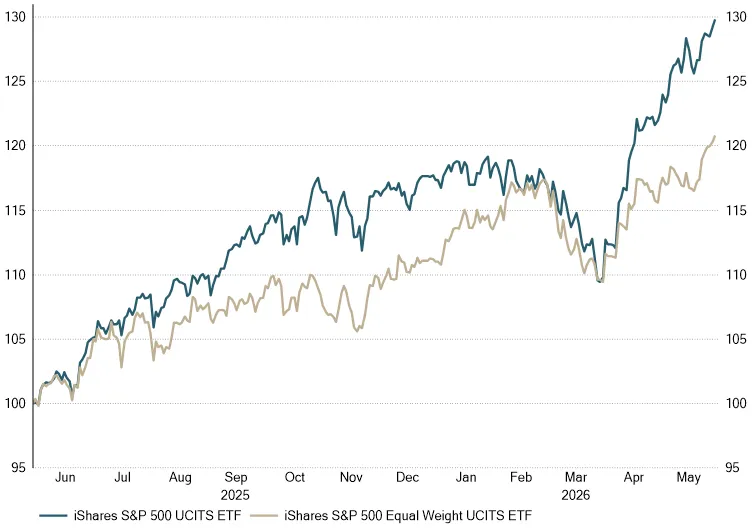
The US equity market closed the week at all-time highs. A narrow cohort of mega-cap AI and semiconductor names continues to generate much of the aggregate index-level returns, whilst the median stock participates far less - in many cases going sideways or declining. Equal-weighted indexes are telling a materially different story to market cap-weighted equivalents.

S&P 500 vs S&P 500 Equal Weight: 1-Year performance

Picture2

Source: T. Bailey, LSEG Workspace. Total return, USD terms, rebased to 100.

What looks, in aggregate, like a strong market is better understood as a bifurcated one: an AI-driven upper tier of companies compounding rapidly on earnings momentum and expanding multiples, and a broad real-economy base that is flat, quietly re-rating downwards, or simply ignored. Snowflake surging 38% in a single session and Dell rising c.30% are expressions of the former. US consumer sentiment near all-time lows, longer-term interest rates at a 25-year highs, and the Strait of Hormuz largely closed illustrate the latter.

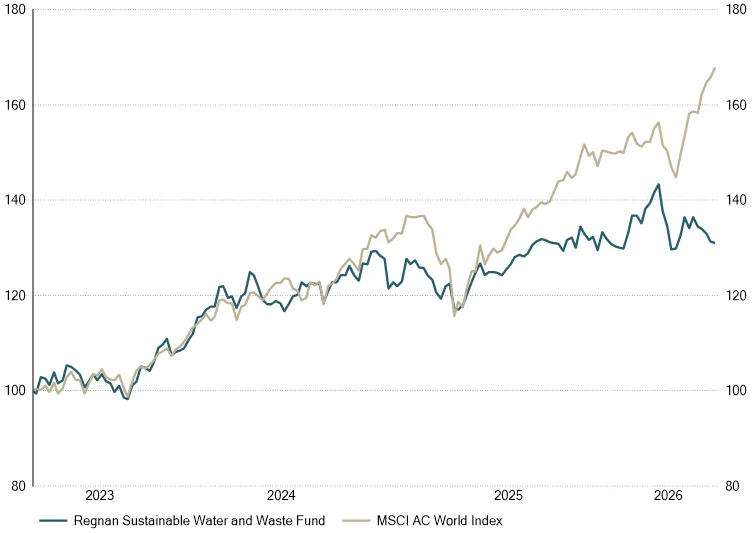
Against this backdrop, we recently met with Bertrand Lecourt, Head of Thematics at Regnan and the senior manager of the Regnan Sustainable Water and Waste Fund - a holding across each of the T. Bailey funds of funds. What was apparent from our discussions is that, away from the noise, it is business as usual for the underlying businesses within the water and waste theme: a story of maintaining steady margins, generating consistent cash flows, and compounding quietly for their shareholders. The portfolio is not priced for excitement - it trades at a moderate multiple of earnings, offers a healthy combination of dividend and buyback yield, and has delivered earnings growth that, over a full investment horizon, points to a total return profile most equity allocators would be satisfied with. That return does not depend on a speculative narrative about what might or could happen, but comes from businesses that bill for water treatment and collect waste today, and will do precisely the same tomorrow.

Regnan Sustainable Water and Waste: 3-year Performance

Picture3

Source: T. Bailey, LSEG Workspace. Total return, GBP terms, rebased to 100.

Nonetheless, the fund has continued to lag the broader market in the second quarter of 2026 - a consequence of the narrowing benchmark as much as a feature of the portfolio itself. Over the past 20 years, water and waste equities have delivered returns comparable to global equities with materially lower drawdowns, and the current portfolio trades at a meaningful discount to global equities on both an earnings and book value basis. Nothing fundamental explains the discount other than investor attention currently sits in another part of the market.

However, we believe the macro backdrop is quietly turning more supportive. US industrial production is rising; construction activity is recovering - a direct volume catalyst for waste businesses in particular. Recycling and commodity prices are improving. Order books are reflecting conditions that the prevailing market narrative has little interest in.

There is also a direct connection between the AI infrastructure build driving equity markets and the businesses inside this fund. Data centres are significant consumers of water, the majority of which is tied to power generation - each plant in the supply chain requires repeated recycling cycles to function. That demand is structural and long-duration, not simply a construction-phase event. The AI economy is building demand for businesses the market is currently content to ignore.

The AI trade is priced, in many cases, for sustained perfection - precisely the condition under which the risk-reward of adding further exposure deteriorates. As we’ve previously discussed, the forthcoming listings of SpaceX and OpenAI may yet prove to be events marking the cycle's peak - the liquidity required to absorb issuance of that scale has to come from somewhere, and the most likely source is the trade that is most crowded.

Water and waste businesses, by contrast, are not weak assets that happen to be cheap. They are strong assets - durable franchises, consistent cash generators, and have pricing power rooted in essential services - that are out of favour because attention has moved elsewhere. In comparison, the AI trade simultaneously requires the narrative to remain intact, sentiment to remain elevated, and earnings to continue surprising to the upside. The water and waste case requires only that the businesses continue doing what they have always done, and to date they are.

Buying quality businesses out of favour has historically been rewarding. The businesses inside this fund went about their work this week - collecting waste, treating water, and compounding - whilst markets celebrated a data cloud company adding US$20 billion to its market capitalisation in a single session.
Back to All Articles