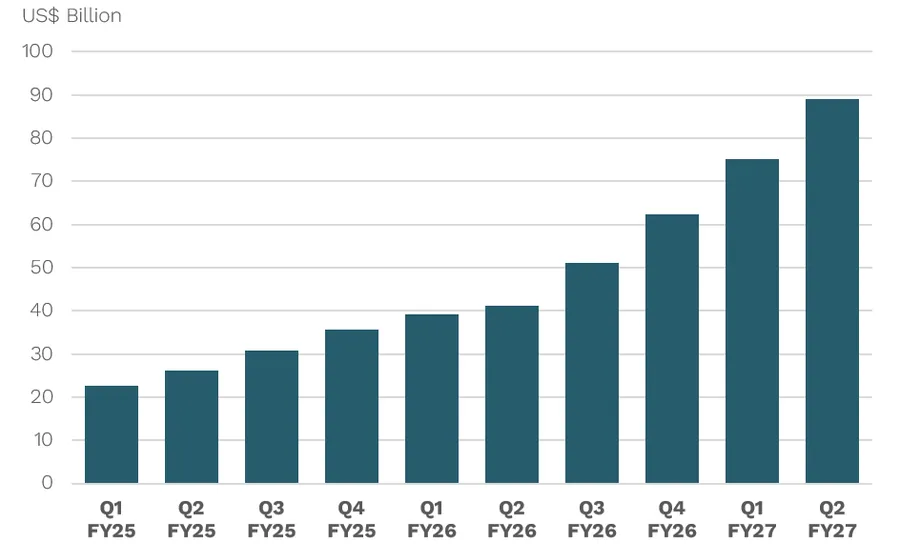
Technology companies, cloud providers and, increasingly, a wider range of businesses continue to spend heavily on chips, servers, data centres, power capacity and networking equipment. Capital-expenditure plans appear to be broadening as corporate profitability improves, potentially extending the investment cycle beyond the handful of US technology companies that started it.
For now, at least, this is supporting economic activity, corporate revenues and equity-market earnings. Nvidia is a major beneficiary because it supplies much of the core equipment required for the build-out. The longer-term challenge is that infrastructure spending is not the same as a proven economic return from that infrastructure. It remains uncertain whether customers will be willing to pay enough for the services created, and how much of the resulting value will accrue to the companies currently committing very large sums of capital.
The largest technology companies have the cash flows and balance sheets to fund this investment. However, the returns required to justify their spending are also high. Model providers face intense competition, software pricing remains uncertain, and demand for AI-enabled services has a long way to catch up fully with the pace of infrastructure construction. Concerns around circular financing in parts of the ecosystem add further reason for caution.
This is not an argument that the AI theme is a bubble, or that the technology will disappoint, but a reminder that the investment case has moved into a more demanding phase. Investors have already rewarded the companies building the infrastructure. The next phase will require evidence that the customers using it can earn attractive returns too.
The extent of AI investment has also been of a scale to carry implications for the wider global economy. That made the new US Federal Reserve Chair Kevin Warsh’s Jackson Hole speech at the end of last week particularly relevant. With the US PCE price index still rising by 3.7% year-on-year in July, and core PCE inflation at 3.3%, Warsh noted that price stability is “not self-executing” and that inflation cannot simply be assumed to fall back to target without further policy action.
Warsh made clear that the Fed remains focused on returning inflation to 2%, although he did not go as far as to commit it to a September rate rise. While AI could eventually raise productivity, reduce costs and provide a disinflationary impulse, in the near-term, effects of the AI build-out make the Fed’s task harder. Building the necessary infrastructure, however, is an investment boom happening now creating demand for energy, equipment, construction, specialist skills and financing at a time when US inflation has not yet returned to target.
This leaves markets in a more balanced position than the headline strength of Nvidia’s figures might imply. Corporate earnings remain supportive and the potential economic benefits of AI are considerable. Yet valuations in parts of the technology sector already reflect a great deal of optimism, while the Fed has signalled that it will not disregard inflation simply because investment is strong.
The appropriate response is not to abandon the theme, but to remain selective. A diversified portfolio should participate in long-term technological change while avoiding excessive dependence on a small group of companies, a single policy outcome or an investment cycle whose ultimate returns are still being tested.