T. Bailey Asset Management Limited do not provide advice to private individuals.

The information contained on this website is intended to provide information about our products and services and is not intended as investment advice. It is important that you do not rely upon its content to make investment decisions without seeking independent advice.

This website is intended for United Kingdom professional investors and advisers only. Please ensure you read the important legal information.

10 March 2025: Weekly Update – Tariffs, Trade Tensions and Market Volatility

Weekly Update
Economic Outlook

Escalating trade tensions and unpredictable US policy actions triggered increased volatility across global equity and currency markets.

On 4 March 2025, the Trump administration introduced a 25% tax on most imports from Canada and Mexico, alongside a 10% duty on Canadian energy products like oil and gas, while doubling tariffs on Chinese goods to 20%. These measures - partially paused just two days later until April for products covered by the USMCA trade agreement - prompted retaliatory tariffs by Canada targeting c.$20bn of US goods.
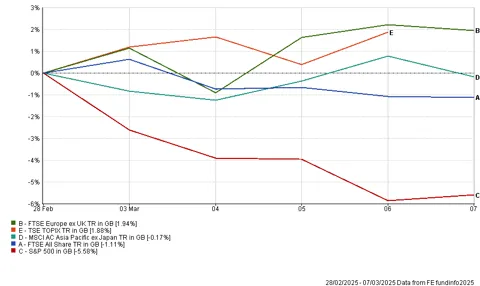
Month-to-date performance of major equity market indices

Picture11

Source: FE Analytics. Total return, Sterling terms.

The White House’s strategy mixes economic pressure with geopolitical bargaining. By temporarily exempting some goods, the aim is to extract concessions - like reducing the flow of migrants into the US. But this haphazard US policy approach does little for economic confidence, particularly as the negative consequences of such policies are immediate whilst any structural benefit to the US may only appear much later. This has been taking its toll on the US stock market and the US dollar, both of which have taken a hit recently, the S&P 500 Index falling 5.6% in Sterling terms so far this month.

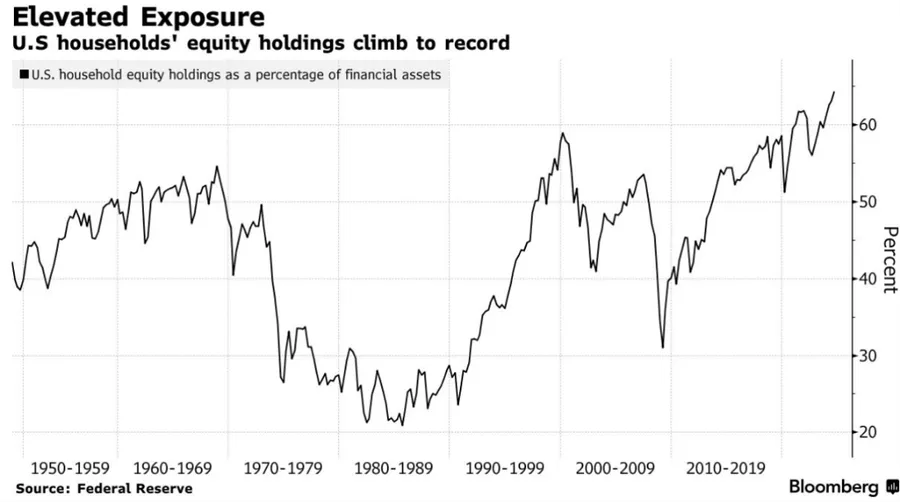
Whilst for now the economic impact has been relatively modest, we remain mindful that there are continuing risks from this policy approach, not least from wealth effects shifting negatively. Outsized market gains have lifted US household assets meaningfully in recent years, but stressful economic conditions typically lead to assets being sold.

Picture12

Source: Bloomberg, 7 March 2025.

Meanwhile, as the US steps back from its international role, Germany announced a massive defence spending plan, equivalent to over 10% of GDP through the next decade, along with a loosening of fiscal policy in lifting its debt brake.

At the beginning of the month we introduced the L&G Europe ex UK Equity UCITS ETF to the three T. Bailey funds of funds portfolios. The two largest sector exposures of this ETF are Financials (20.6%) and Industrials (18.5%) which should both be beneficiaries of reindustrialisation.

The position was partly financed through trimming the First Trust Cybersecurity ETF (held in the T. Bailey Global Thematic Equity and T. Bailey Multi-Asset Growth Funds), a predominantly US equity based theme. In addition, the Royal London Sustainable Leaders Fund (held across all three T. Bailey funds of funds) was also trimmed, partly recognising that this fund has a bias to UK large cap equities where US dollar earnings are more likely to feature.

Back to All Articles