T. Bailey Asset Management Limited do not provide advice to private individuals.

The information contained on this website is intended to provide information about our products and services and is not intended as investment advice. It is important that you do not rely upon its content to make investment decisions without seeking independent advice.

This website is intended for United Kingdom professional investors and advisers only. Please ensure you read the important legal information.

11 May 2026: Weekly Update – UK Fiscal Pressure, Gilt Yields and Inflation Risks

Weekly Update
Multi-Asset Investing

The combination of persistent inflation, rising gilt yields and political instability continued pressuring UK financial markets and reinforcing the need for diversification.

Last week's UK local elections delivered a sweeping defeat for the governing Labour party, and UK long-dated gilt yields briefly touched levels not seen since the late 1990s.

To be fair, longer-dated yields had been rising steadily ahead of polling day, driven by an energy shock since late February that has pushed UK inflation to 3.3% and which the OECD now forecasts averaging around 4% for the full year. The local election result has added a political risk premium on top: bond markets have been sensitive to any signal about the durability of the UK's fiscal framework since 2022, and the scale of Labour's losses raises questions about that durability.
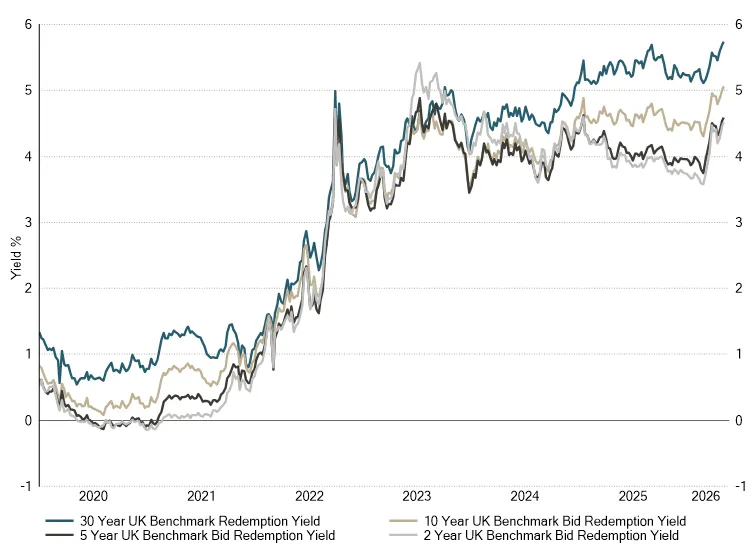
UK Conventional Gilt Benchmark Yields

Picture2

Source: LSEG Workspace

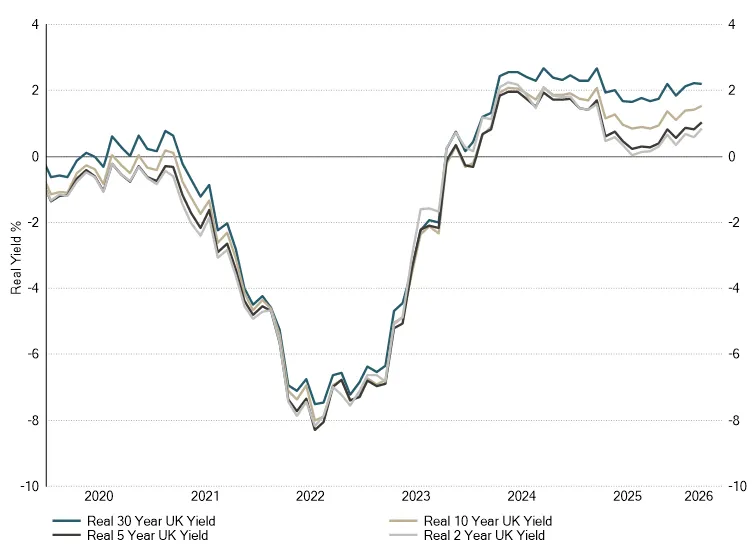
UK base rates are currently held at 3.75%, posing the Bank of England an unenviable choice. Inflation remains well above target, growth is barely positive. Tightening into a slowing economy risks amplifying the damage. However, holding risks appearing to accommodate inflation. The most likely outcome remains a prolonged hold - meaning short-dated gilt yields remain elevated and attractive, but that the shape of the yield curve, and the real returns available from longer maturities, are less compelling than their headline numbers imply. Much of the rise in nominal yields reflects higher inflation expectations rather than a better real return for lending to the UK government; on a real yield basis, the improvement is considerably more modest.

UK Conventional Gilt Real Yields

Picture3

Source: LSEG Workspace. Data to the latest UK CPI release for March 2026.

Even so, gilt yields at these levels will attract investor attention, and, in specific circumstances, offer a genuine opportunity. A low-coupon gilt bought at a discount to par offers a higher-rate taxpayer a gross equivalent yield that has rarely looked more attractive - with the price accretion sheltered from capital gains tax. However, there are also clear risks: any further deterioration in the fiscal outlook could push long-dated yields higher still before they eventually settle. We continue to favour shorter-dated UK government bonds over long and are not extending duration until there is greater clarity on both the energy shock and the political backdrop.

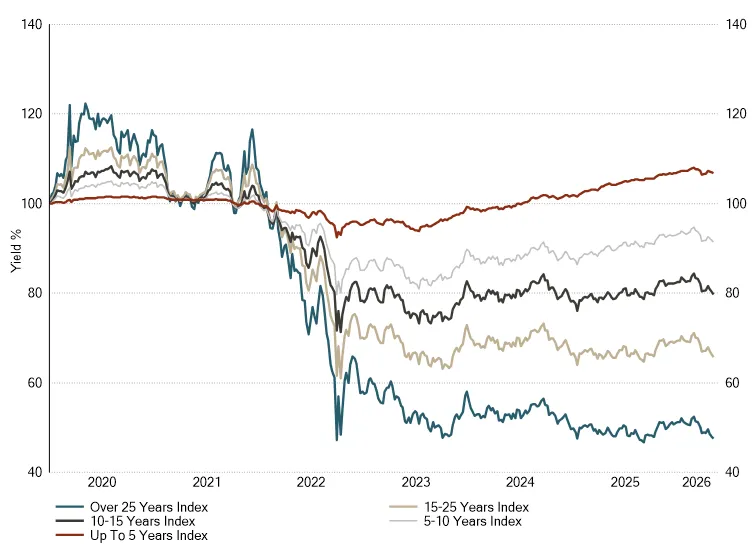
Performance of UK Gilts

Picture4

Source: LSEG Workspace. Total return, rebased to 100 on 31 December 2019.

For UK equities, the picture is more nuanced. In aggregate, UK based companies generate most of their revenues from overseas. They also trade at a material valuation discount to most other developed markets - one that already prices in a substantial degree of caution and which changes the risk profile of owning them considerably. That said, domestically-exposed businesses - consumer-facing companies, housebuilders, smaller companies with limited pricing power - face a genuine squeeze from higher mortgage costs and weakening real incomes, and we remain selective in that part of the market.

Across the T. Bailey Multi-Asset funds, short-duration fixed income positioning has protected investors from the worst of the gilt sell-off. Holdings in gold, copper and absolute return strategies continue to provide ballast in a volatile, inflation-sensitive environment. Our equity positioning - biased towards Asia, emerging markets and thematic areas with durable pricing power such as healthcare and infrastructure - is built around a range of outcomes rather than a single macro forecast. The UK's uncomfortable economic arithmetic - persistent inflation, weak growth, political uncertainty - is unlikely to resolve quickly. Patient diversification across asset classes and geographies remains, in our view, the appropriate stance

Back to All Articles