T. Bailey Asset Management Limited do not provide advice to private individuals.

The information contained on this website is intended to provide information about our products and services and is not intended as investment advice. It is important that you do not rely upon its content to make investment decisions without seeking independent advice.

This website is intended for United Kingdom professional investors and advisers only. Please ensure you read the important legal information.

14 September 2026: Weekly Update – UK Growth and the Case for Selective Equities

Weekly Update
T. Bailey Fund Range Economic Outlook Global Equities

The UK economy is growing more steadily than many expected, but the recovery remains narrow and consumer-facing activity is still weak. For UK equity investors, that argues for selectivity rather than a broad domestic growth bet, with quality, resilience and cash generation remaining particularly important.

The UK economy is growing, but not yet broadly. That creates a selective equity backdrop in which quality, resilience and cash generation remain more valuable than a simple domestic growth story.

July’s UK GDP figures reported on Friday show an economy holding up better than many had expected. The ONS reported growth of 0.4% in July, and also growth of 0.4% over the three months to July compared with the three months to April, representing the eighth consecutive period of three-month expansion. This is genuinely encouraging and points to steady, albeit narrow, growth.

On the month, all three main sectors - services, production and construction - grew modestly in July, with services (+0.4%) doing the heavy lifting. But the picture is more mixed over the three months with production and construction both falling while services rose. Within services, consumer-facing areas, including retail and hospitality, were weaker in July even as business-facing activity improved.
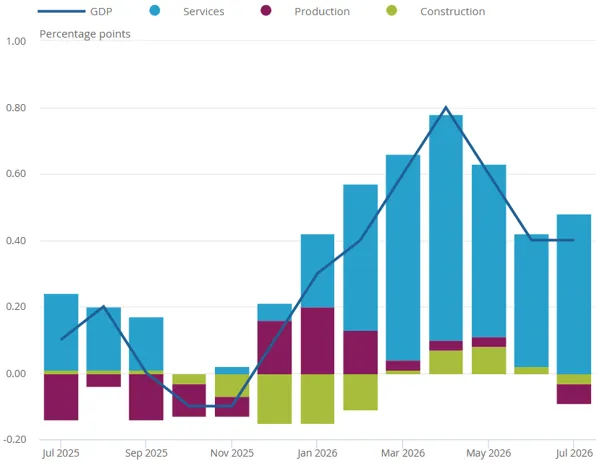
Contributions to three-month UK GDP growth

Picture1

Source: Office for National Statistics. Gross domestic product monthly estimate.

In short, the economy is growing, but through a narrow expansion led by professional and digital services while consumer-facing activity remains weak and construction remains subdued. This is hardly the profile of a fully broad-based recovery.

At the margin, stronger activity should help tax receipts and the deficit-to-GDP ratio a little - welcome news ahead of the Autumn Budget yet unlikely to materially expand the Chancellor’s room for manoeuvre.

Higher gilt yields, debt-interest costs and energy-related inflation are likely to absorb much of any improvement in fiscal headroom. This means difficult choices on tax, spending and fiscal priorities are likely to remain, while scope for broad fiscal stimulus stays limited.

This environment is likely to favour financially robust businesses over those whose investment case depends on lower interest rates. It is also likely to keep pressure on household finances and the most domestically sensitive parts of the market. For UK equities, that argues for selectivity: favouring companies with strong balance sheets, dependable cash generation, pricing power and diversified sources of demand.

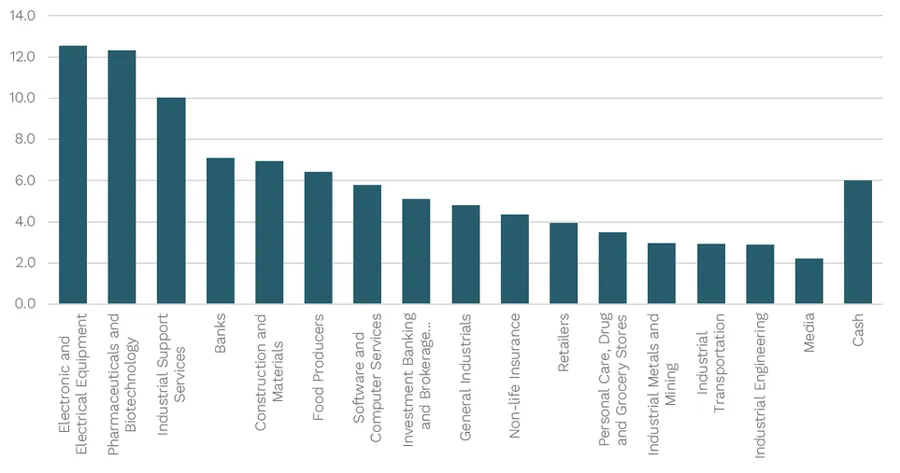
For the WS T. Bailey UK Responsibly Invested Equity Fund, this backdrop is broadly supportive of the types of financially robust businesses the portfolio seeks to own. Holdings span technology services, specialist industrials, healthcare, financial services and consumer-related businesses, with many supported by differentiated products, structural demand or internationally diversified revenue streams.

Companies linked to automation, digital infrastructure, specialist engineering and global capital spending can benefit if activity remains firm. The Fund’s healthcare and more defensive consumer exposure provides useful balance, offering some ballast if higher energy and borrowing costs weigh further on domestic demand. The Fund’s responsible-investment screening limits direct exposure to fossil-fuel producers, so it would not expect to fully participate in a commodity-led rally, but a more sustained recovery in business investment and global capital spending would be a helpful tailwind. Nonetheless, individual company execution, valuations and overseas demand will remain important drivers of performance.

T. Bailey UK Responsibly Invested Equity Fund: Sector Weights

Picture2

Source: T. Bailey, portfolio sector weights as at 11 September 2026.

July’s GDP data are encouraging, but not a reason to make a broad bet on UK domestic recovery. The more durable case for holding UK equities rests on strong balance sheets, global revenue diversification, cash generation and pricing power. If firmer growth ultimately delays interest-rate cuts while energy costs remain elevated, the case for quality and resilience looks more compelling than one built on broad domestic cyclicality.

Download article as a PDF
Back to All Articles