T. Bailey Asset Management Limited do not provide advice to private individuals.

The information contained on this website is intended to provide information about our products and services and is not intended as investment advice. It is important that you do not rely upon its content to make investment decisions without seeking independent advice.

This website is intended for United Kingdom professional investors and advisers only. Please ensure you read the important legal information.

16 February 2026: Weekly Update – The ‘pAIn Trade’ and AI Market Repricing

Weekly Update
Thematic Investing

The market’s “pAIn trade” accelerated as investors rapidly reassessed the long-term impact of artificial intelligence on business models and valuations.

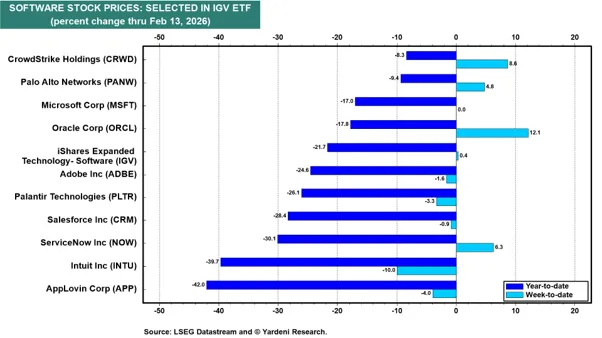
This year we’ve seen the artificial intelligence theme abruptly transition from being an unquestioned engine of equity market performance to a source of investor unease. Anxiety about AI disruption that initially focused on software has broadened into a market‑wide “pAIn trade” in which any business model perceived as vulnerable has been marked down aggressively. Software, brokerage, logistics and real‑estate‑linked stocks have all suffered sharp falls on the back of relatively limited news, as investors worry that AI‑enabled competitors could compress margins, accelerate client churn or render intermediation models obsolete. Market action has seen a “sell first, ask questions later” mentality in which a single AI headline can wipe out months of gains, even in companies that are already investing heavily in the technology themselves. This stands in contrast to the recent past, when AI was treated almost uniformly as a positive narrative and a justification for ever higher valuations across a narrow leadership group of perceived winners.

Yet, for now, this looks more like a violent rotation than an outright risk‑off episode. Headline equity indices have only modestly changed year‑to‑date, masking significant damage underneath the surface in AI‑exposed segments. Capital has been rotating out of expensive growth and AI beneficiaries and into cheaper, more traditional sectors such as financials, industrials and utilities, where AI is increasingly viewed as a potential productivity tool rather than an existential threat. This rotation has been particularly helpful for the S&P 500 equal‑weight index, which gives more influence to the broader cohort of previously neglected, lower‑valuation stocks benefiting from the shift, and less to the handful of mega‑cap AI leaders that have come under pressure.
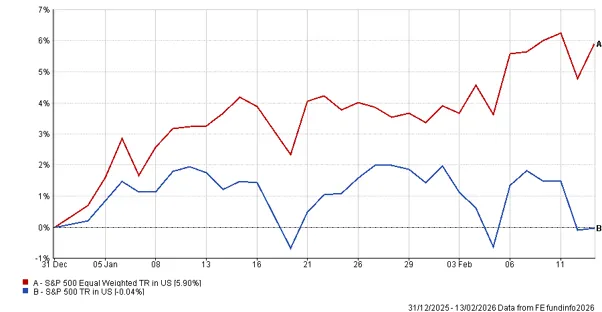
Large Cap US Equity Performance: Market Capitalisation and Equally Weighted YTD

Picture3

Source: FE Analytics. In total return, USD terms.

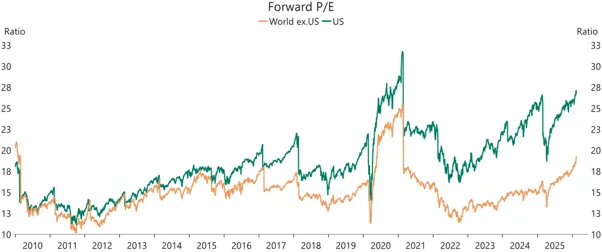
Even within technology, there is a growing divide between high‑multiple software and information‑services names, now under pressure, and the infrastructure enablers of AI - notably semiconductors and data‑centre‑linked businesses - which remain better supported by tangible investment spend. The common thread is valuation: those areas that entered 2026 on elevated multiples relative to the wider market and their own history have had the furthest to fall as investors reassess who will actually capture the long‑term economics of AI.

US P/E ratio is 40% higher than the P/E ratio for the world ex US

Picture4

Note: US = SPX Index; World-ex US = MSCI World ex-USA Index. Source: Apollo, Bloomberg, Macrobond.

The speed and breadth of the pAIn trade means a growing number of fundamentally sound companies are being punished chiefly for sitting in the “wrong” bucket. Brokerages, information providers, insurance intermediaries and logistics firms with strong balance sheets and real‑world networks have been sold off alongside weaker peers purely because AI is seen as a threat to parts of their value chain. In some cases, the market reaction looks misaligned with the underlying economics and there are early signs that investors are beginning to differentiate, with some of the hardest‑hit names stabilising in recent days as the initial wave of forced selling exhausts itself and attention turns back to balance‑sheet strength, pricing power and a company’s ability to deploy AI internally. The next phase of this theme is therefore likely to be intensely bottom‑up, as active managers separate those whose moats are genuinely eroding from those that can harness AI to defend or even enhance their franchises.

Selected Software Stock Prices: Year and week to date (13 February 2026)

Picture5

Source: Yardeni Research.

In this environment, the structure of the T. Bailey funds of funds provides useful diversification away from the most crowded parts of the US‑centric AI trade. The T. Bailey funds maintain a lower allocation to US equities than many global peers, with greater emphasis on the UK, Japan, Asia and emerging markets, where index leadership has been less dominated by a small group of mega‑cap AI beneficiaries. The thematic architecture also tilts towards areas where AI looks more like an enabler than a direct competitor: healthcare, insurance, water and waste, and broader global value strategies that focus on cash‑generative businesses at more modest valuations. Holdings such as Regnan Sustainable Water & Waste and dedicated insurance and healthcare exposures sit alongside global value funds and select automation or AI‑related themes, creating a balance between beneficiaries of efficiency gains and franchises rooted in regulated, asset‑heavy or necessity‑based demand. While no portfolio is immune to indiscriminate selling, this blend of regional diversification and exposure to structurally important but less obviously disintermediated sectors should provide the T. Bailey funds with a degree of resilience, while retaining the flexibility to re‑deploy capital as genuine opportunities emerge from the current volatility.

Back to All Articles