T. Bailey Asset Management Limited do not provide advice to private individuals.

The information contained on this website is intended to provide information about our products and services and is not intended as investment advice. It is important that you do not rely upon its content to make investment decisions without seeking independent advice.

This website is intended for United Kingdom professional investors and advisers only. Please ensure you read the important legal information.

16 May 2025: Weekly Update – US-China Tariff Pause and Market Fragility

Weekly Update
Market Commentary

A temporary pause in US-China tariffs sparked a sharp market rally, though structural economic and geopolitical risks continued to threaten stability.

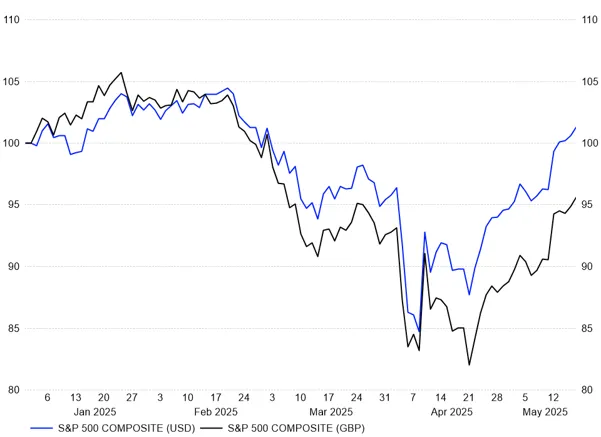
This past week, global financial markets experienced a dramatic rally, particularly in the United States, driven by a pause on tariffs between the US and China. This development has significantly eased immediate downside risks, restoring investor confidence and propelling the S&P 500 to recover its year-to-date losses. However, for UK-based investors, the gains have been mitigated by the concurrent decline in the US dollar, leaving returns still in negative territory when measured in sterling.

S&P500 Year-to-Date in USD and GBP terms

Picture9

Source: LSEG Workspace.

The reduction in tariffs has had a ripple effect across the economic landscape. In the US, GDP forecasts have been modestly upgraded, and inflation expectations have been revised downward, reducing fears of a stagflationary scenario. The Federal Reserve has adopted a cautious, wait-and-see approach, contrasting with the European Central Bank’s anticipated proactive policy stance. Despite the strong equity performance, our concerns linger about the sustainability of these gains, especially in light of stretched US equity valuations.

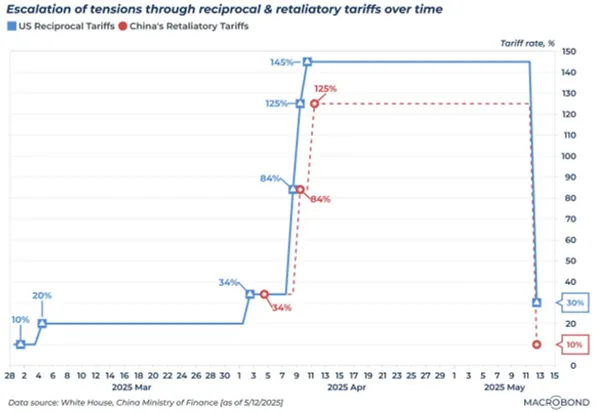
Chronicles of the US-China Trade Standoff

Picture10

Source: Denys Liutyi, Macrobond.

On the geopolitical front, US economic ties with Saudi Arabia have deepened through a record-breaking $142 billion arms deal and expanded collaboration in technology sectors, notably artificial intelligence, with companies like Nvidia poised to benefit.

However, despite the recent market buoyancy, risks remain. The temporary nature of the current US-China trade agreements presents uncertainty, with deadlines that could reignite volatility if substantive progress isn’t made. Structural issues, such as industrial policy disputes and global imbalances, are unlikely to be resolved soon. Meanwhile, in Europe, whilst Germany’s fiscal loosening offers a modest lift, longstanding challenges to economic growth could limit its potential.

Overall, while the immediate threat of a global trade war has receded, the path ahead remains uncertain. Market optimism is buoyed by recent developments, yet it is fragile, with potential for renewed instability should fundamental disagreements between key global players persist.

That fragility will be tested this week following Friday’s after close announcement by Moody’s, the credit rating agency, that it was lowering its credit rating for the US. This further adds to the pressure for capital to continue to flow away from the US and into Europe and Asia. Pricing in a higher term premium for the US is a further manifestation of the risks facing US equities and the dollar.
Back to All Articles