T. Bailey Asset Management Limited do not provide advice to private individuals.

The information contained on this website is intended to provide information about our products and services and is not intended as investment advice. It is important that you do not rely upon its content to make investment decisions without seeking independent advice.

This website is intended for United Kingdom professional investors and advisers only. Please ensure you read the important legal information.

17 August 2026: Weekly Update – Inflation, Jobs and Record Equity Markets

Weekly Update
Economic Outlook Market Commentary

Softer US inflation and a surprisingly weak jobs report are pulling Federal Reserve expectations in different directions, yet equity markets continue to reach record highs. With commodities unsettled and UK policymakers facing their own inflation dilemma, the outlook remains anything but clear.

It's been a quiet week for market headlines, but less so for the UK's skies. July's inflation and jobs numbers are pulling the US Fed in opposite directions, while equities are powering on regardless.

There was much talk of the solar eclipse and the Perseids meteor shower in the office this last week. Wednesday's partial solar eclipse covered around 90% of the Sun here in the East Midlands, and with the new moon leaving the skies dark, a few of us stayed up late for the Perseids’ peak too. Quite unlike markets, it's one of the few things you can predict with certainty to the minute, decades or more in advance. Not that many had taken the trouble to prepare for it, given the country's shortage of solar eclipse glasses.

In the murkier world of economic data, July's US CPI print eased to 3.4% year on year, with core CPI down to 2.5%. US Fed funds futures now put the odds of a September hike at around 30%, down from close to a flip of a coin before the release but still a meaningful number to be pricing in. The Fed's policy rate remains at 3.5% to 3.75%, headline inflation remains 1.4% above target, and several officials have talked openly about hiking further if the trend doesn't hold. While softer data is helpful for the Fed, it isn't an all-clear signal.
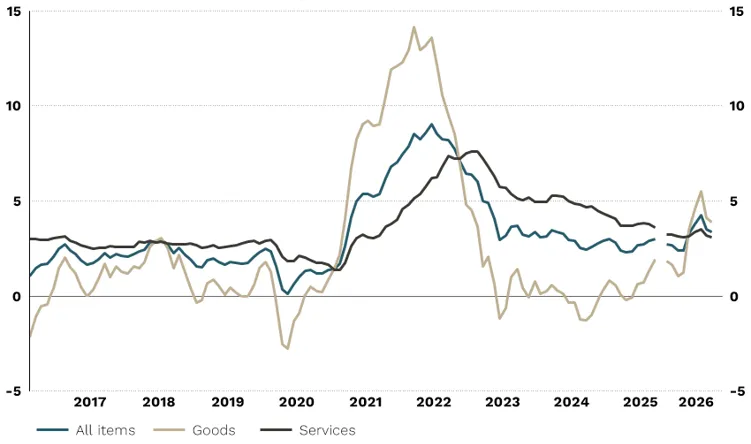
US CPI: 12-month percent change

Picture2

Source: LSEG Workspace.

The bigger shock came at the end of the prior week where payrolls were reported to have fallen by 23,000 in July, against forecasts of 80,000 to 95,000, and wage growth of 3.2% now sits behind inflation, so the average US worker took a real pay cut last month. Sticky prices next to a stalling jobs market is a harder call for the Fed.

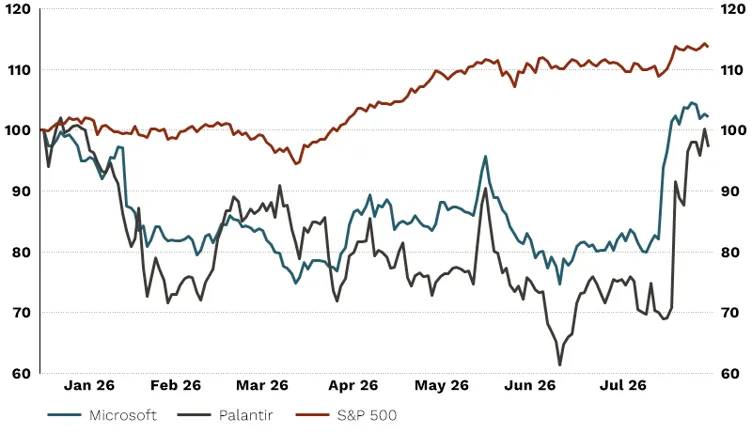
None of this has slowed the progress of equity markets. The S&P 500 index has continued to set fresh records, as some of the year-to-date laggards turned into leaders. Microsoft has clawed its way back to a positive year to date return and Palantir has similarly moved up close to 30% over the last month on an earnings driven surge. Hyperscaler capex is on track for close to US$800bn this year, feeding into industrials and semiconductors, the same choppy Ceasefire Trade, AI Concentration setup we've flagged before. A market this reliant on a handful of names is vulnerable if one of them disappoints.

US Equities: Year-to-date

Picture4

Source: LSEG Workspace. Total return in GBP terms, rebased to 100

Oil and gold are both reacting to the same uncertainties. Brent has hovered in the high US$80s this week on the Iran-Oman talks over reopening the Strait of Hormuz, still running at a fraction of pre-conflict shipping volumes, while gold has rebounded to around US$4,400 on the softer CPI print but remains some US$1,000 off its January high. Overall, much of the commodity complex looks unsettled. Copper hit a fresh record in early August on tight supply and AI-driven grid demand while silver is in the early throes of clawing back from a roughly 50% correction after its own record high earlier this year.

Recent UK data has held up better than many have expected. June GDP rose 0.3% against a forecast of no growth, while UK CPI at 2.6% remains comfortably below the US figure. UK equities have had a strong run too, with the FTSE 100 hitting a record high in late July and up around a fifth over the past year. Bigger risk may sit elsewhere however. As a trade-dependent, energy-importing economy, the UK is more exposed than most to the kind of imported inflation shock coming out of the Middle East, and the Bank of England's own July vote, held 6-3 with three members pushing to hike, suggests policymakers share that concern.

Looking ahead, September is shaping up to be a finely balanced month for US policy: the 4 September jobs report feeds directly into the FOMC meeting on 15-16 September, and a weak payrolls print would pull the odds of a hike towards zero while a strong one keeps that possibility alive. For UK investors, the Bank of England’s 17 September meeting will be just as important given the UK’s exposure to imported inflation and the split of the vote at the last meeting. None of that carries the certainty of Wednesday's partial eclipse - the next total eclipse from the UK isn't due until 2090 and nobody needs to guess when it's coming.

Back to All Articles