T. Bailey Asset Management Limited do not provide advice to private individuals.

The information contained on this website is intended to provide information about our products and services and is not intended as investment advice. It is important that you do not rely upon its content to make investment decisions without seeking independent advice.

This website is intended for United Kingdom professional investors and advisers only. Please ensure you read the important legal information.

22 June 2026: Weekly Update – Let the Oil Flow

Weekly Update
Market Commentary

A ceasefire agreement between the US and Iran triggered a sharp fall in oil prices and a broad relief rally across global markets. However, inventory shortages, inflation lags and differing central bank responses suggest investors may be underestimating how long the economic effects of the recent energy shock could persist.

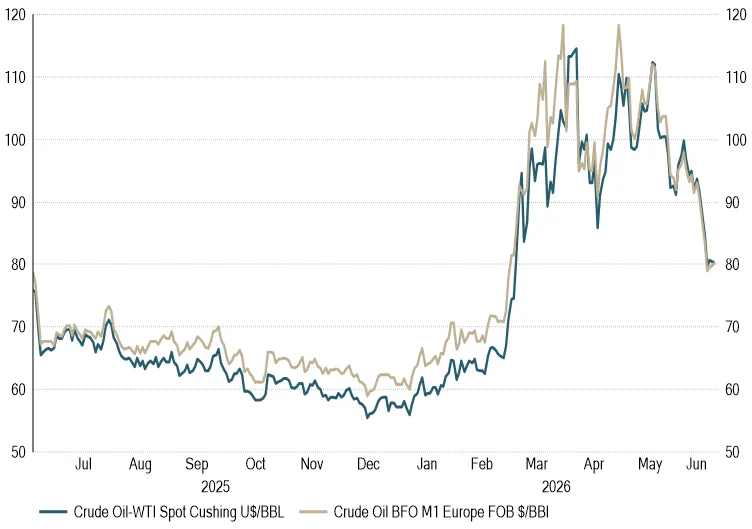
US President Donald Trump announced a “Memorandum of Understanding” with Iran at the start of the week, as a precursor to formal negotiations and a ceasefire, that was formally signed at Versailles on Wednesday. The Strait of Hormuz reopens toll-free for sixty days and US$300 billion has been earmarked for Iran’s reconstruction. Brent crude fell as Trump proclaimed, “Let the oil flow” and Asian markets dutifully rallied 3 to 5%, European stocks gained 1 to 2%, and consumer and industrial sectors were bid up hard on both sides of the Atlantic.

Brent Crude Oil Prices

Picture1

Source: LSEG Workspace.

By Friday the picture had changed somewhat. Direct US-Iran talks scheduled for Switzerland were postponed, albeit not cancelled, after renewed fighting between Israel and Hezbollah forced a separate ceasefire before anything further could proceed. The Strait stayed effectively closed for much of the week, with shipping trackers recording few transits until an uptick on Friday. A sixty-day framework has been signed but how long it holds remains uncertain.

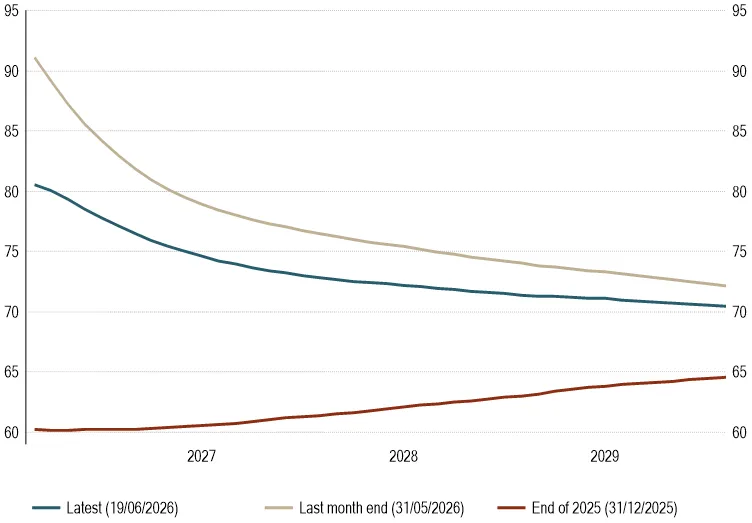
Even if the agreement removes the immediate worst-case scenario for now, it does not eliminate the inflation shock. Physical crude markets remain tight and any meaningful normalisation in supply conditions will take time. During the conflict, inventory drawdowns across OECD economies and China did much of the work to contain a more acute oil shock. Those inventories now sit near levels that, in past episodes, have coincided with oil above US$100 a barrel when supply failed to resume promptly. The forward curve has eased somewhat, but longer-dated contracts still trade above US$70, underlining how much uncertainty remains embedded in the outlook.

Oil Futures Curve

Picture2

Source: LSEG Workspace.

Even a durable agreement is unlikely to soften inflation data quickly. European household energy bills are typically linked to wholesale gas prices with a three-to-six-month lag, and the UK’s energy price-cap cycle works in a broadly similar way. Much of this year’s earlier energy-price shock has therefore yet to feed fully into consumer prices. UK CPI inflation held at 2.8% in the year to May, while US core inflation remains elevated. The broad point is that pipeline effects are likely to keep inflation pressure firmer into the third quarter than the headline moves in oil alone might suggest. The agreement is clearly helpful at the margin, but, all else being equal, its disinflationary effects are more likely to arrive slowly and unevenly than immediately.

That has formed the backdrop for the five major central banks that have met over the past fortnight, all facing the same global energy shock but needing to respond in different ways. The Bank of Japan raised rates to 1.0%, the highest level since 1995, continuing a tightening cycle driven by domestic wage and price pressures that predate the Iran crisis. The ECB hiked its deposit rate to 2.25% the previous week, its first increase in nearly three years, to stop higher energy costs feeding into longer-term expectations. The US Federal Reserve held at 3.5 to 3.75% in Kevin Warsh’s first meeting as Chair, but nine of eighteen participants now expect at least one more rate rise this year, a reflection of strong growth, a tightening labour market and core PCE running above target. The Bank of England also held at 3.75% on a 7-2 vote, with two members wanting an immediate hike and the majority offering no guidance on when cuts might begin. The important point to note is that different regions are choosing different policy paths at the same time.
Equity Returns: 1 Month

Picture4

Source: LSEG Workspace. Total return in GBP terms

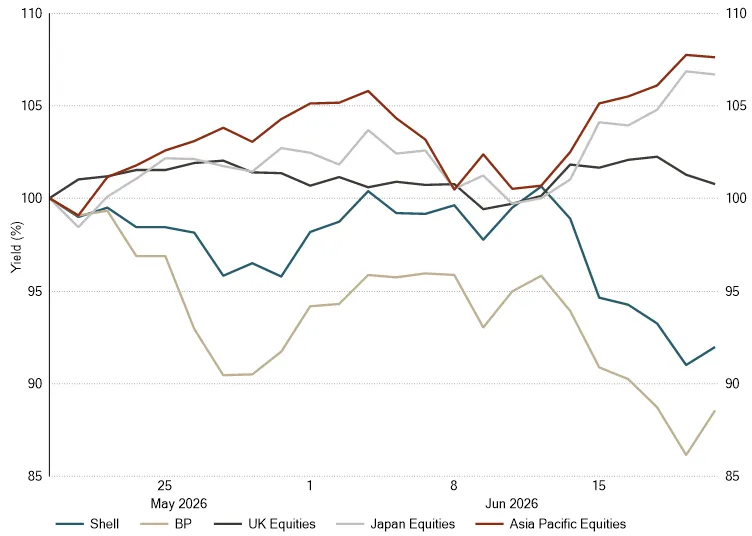
This was underlined by the reaction of equity markets. The FTSE 100 rose only modestly on the day of the Iran announcement, while the Nikkei jumped 5% and major European indices gained more than 1%. Index composition was a differentiating factor with the major oil companies of BP and Shell both heavily weighted in the FTSE 100 and falling as oil prices dropped. A UK equity index investor captured much less of the “energy relief rally” than a Japanese or broad Asian index investor, not because the macro news was different but because the local benchmark was dominated by different sectors. In an environment where regional and sector fortunes are diverging, sticking rigidly to backward‑looking market capitalisation weights risks leaving portfolios misaligned with the macro forces now driving returns.

Back to All Articles