T. Bailey Asset Management Limited do not provide advice to private individuals.

The information contained on this website is intended to provide information about our products and services and is not intended as investment advice. It is important that you do not rely upon its content to make investment decisions without seeking independent advice.

This website is intended for United Kingdom professional investors and advisers only. Please ensure you read the important legal information.

23 March 2026: Weekly Update – Energy Shock, Tail Risks and Global Diversification

Weekly Update
Economic Outlook Multi-Asset Investing Market Commentary

Markets have rapidly priced the risks of prolonged disruption to Gulf energy supplies, but the political incentives still point towards an eventual off-ramp. Beyond the immediate shock, the crisis could accelerate significant changes in energy security, US asset risk and global diversification.

In periods of shock, markets often seize on the worst plausible outcome and treat it as the base case. That instinct is evident now. Missile strikes on Qatar's Ras Laffan facility have removed around 17% of the country's LNG export capacity for several years, while the effective near‑closure of the Strait of Hormuz has produced the largest disruption to energy and global supply chains in decades. For European importers still adjusting to life after Russian gas, and for Asian economies that built their industrial models on cheap and reliable Gulf energy, this is a genuine and protracted terms‑of‑trade shock. The likely macro pattern is familiar: higher headline inflation, weaker real incomes and pressure on energy‑intensive industries.

However, the political incentives around the conflict point towards seeking an exit rather than prolonging it. The US administration faces elections later this year, at a time when poll data show a clear majority of voters dissatisfied with both the economy and the cost of living. A prolonged energy squeeze would reinforce that pressure. It is therefore notable that Washington has characterised the conflict in relatively contained terms, while Iran has allowed selective passage through Hormuz, reduced the pace of strikes and framed its restraint as conditional rather than unilateral - together offering a plausible path to de‑escalation. Admittedly, that path narrowed considerably towards the end of the week as renewed strikes on Gulf energy infrastructure sent Brent briefly towards US$120 a barrel, and the weekend brought a US ultimatum to reopen Hormuz met by Iranian threats to close it entirely and strike critical infrastructure across the region. Even so, the off‑ramp remains our base case - the underlying political and economic incentives on both sides have not changed - but the window is narrower and more fragile than it appeared only days ago, and the range of potential outcomes around that base case has widened.
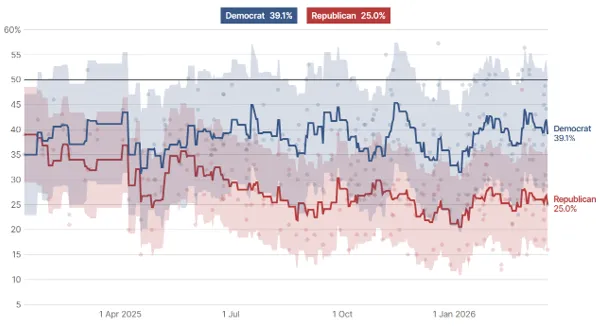
US Generic Congressional Ballot - Independent Voters

Voters who do not identify as either Democrat or Republican (swing segment of the electorate)

Picture3

Source: Decision Desk HQ (Generic Congressional Ballot (Independents) | DDHQ).

More important over time is the damage this conflict may do to the United States itself - not via the energy shock, which the US can better absorb, but via slower‑moving channels. The first is strain on the petrodollar system. Structural demand for dollars, which has helped keep US borrowing costs low, rests in part on Gulf energy being priced in dollars, recycled into US Treasuries and underpinned by American security guarantees. Launching a war without close consultation with the Gulf states most affected will have weakened those relationships, while moves by Iran and some buyers to explore yuan‑denominated crude settlements represent an early challenge to that architecture. The second channel is alliance erosion. Key European allies have declined to participate in military operations in and around the Strait of Hormuz, stressing that this conflict falls outside NATO’s defensive remit, and making future broad coalitions harder to assemble. Finally, the US entered 2026 with deficits already on an unsustainable trajectory at full employment and a debt profile that was beginning to attract a higher term premium from the bond market. War spending, an inflation impulse that slows Federal Reserve easing and higher debt‑servicing costs all argue for a structurally higher risk premium on US assets.

For the rest of the world, the picture is more mixed than the immediate pain suggests. The short‑term impact on energy‑importing Asia is severe and, for the most vulnerable economies, destabilising, but major energy shocks have historically forced adjustments that leave economies more resilient in their aftermath. The current crisis has exposed Asia’s reliance on a single corridor and a single major LNG supplier, and should accelerate investment in renewables, a revival of nuclear and broader supply diversification. The immediate beneficiaries are US and Australian LNG exporters, Atlantic Basin crude producers such as Brazil and Guyana, and commodity producers whose output can reach markets without passing through Middle Eastern chokepoints. More fundamentally, the crisis is pushing the system away from the globalised, just‑in‑time energy model of recent decades towards one in which security of supply takes precedence over lowest cost.

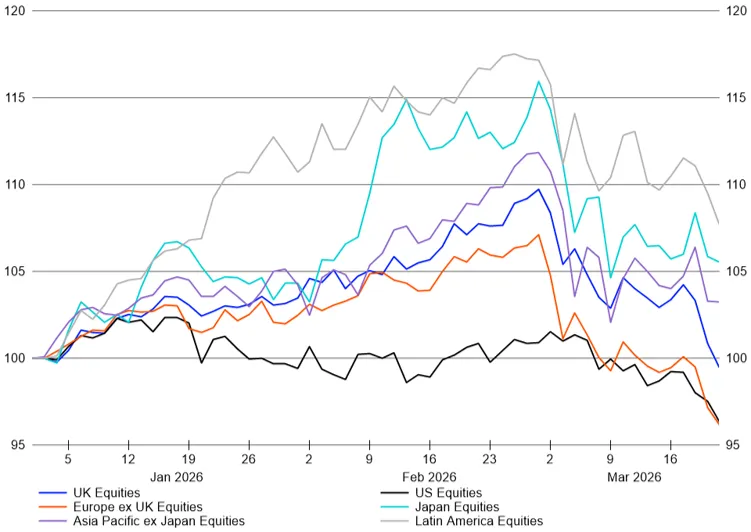
Regional Equity Markets: Year-to-date

Picture4

Source: LSEG Workspace. Total return, GBP terms. Rebased to 100 on 31 December 2025.

For the T. Bailey portfolios, the implications reinforce rather than challenge the positioning we have been building through 2026: a lower allocation to US equities than many peers, meaningful exposure to real assets as a hedge against fiscal and monetary degradation, thematic tilts towards healthcare, water and infrastructure where pricing power is more durable, and a deliberate emphasis on active managers in regions such as Japan and emerging markets where stock selection becomes more important as volatility rises. The month-to-date performance numbers reflect a difficult few weeks for risk assets broadly - there has been nowhere straightforward to hide when an energy shock of this magnitude hits simultaneously across equities, bonds and currencies - and we do not pretend otherwise. What we can say is that the diversification within the portfolios has cushioned some of the impact relative to more concentrated peers, and that the structural case for how they are positioned has been strengthened, not weakened, by the events of the past month. Our base case for the coming weeks remains a managed, if uncomfortable, off‑ramp, with markets currently priced for outcomes that look materially worse. The base case for the coming years is a less globalised, more resource‑conscious world, in which the structural case for reducing dependence on US assets - already evident before this conflict - continues to build.

Back to All Articles