T. Bailey Asset Management Limited do not provide advice to private individuals.

The information contained on this website is intended to provide information about our products and services and is not intended as investment advice. It is important that you do not rely upon its content to make investment decisions without seeking independent advice.

This website is intended for United Kingdom professional investors and advisers only. Please ensure you read the important legal information.

23 May 2025: Weekly Update – Fiscal Deficits, Bond Markets and Rising Term Premiums

Weekly Update
Economic Outlook

Government bond markets remained under pressure as rising fiscal deficits and increased debt issuance pushed yields to multi-decade highs.

Long-term government bond yields have continued to climb in recent years as financial markets react to the prospect of ever larger fiscal deficits. This concern has been particularly notable this week for the US following the House of Representatives passage of President Trump’s “Big Beautiful” bill - a sweeping package of tax cuts, spending changes, and a significant increase in the national debt ceiling.

Investors are increasingly demanding higher yields to compensate for the anticipated volume of new US treasury issuance needed to finance the bill, which is projected to add in the region of $3 to $5 trillion to the national debt over the next decade. The resulting selloff in long-dated US treasuries has pushed yields to levels not seen in nearly two decades, raising long-term borrowing costs and amplifying concerns about the sustainability of US fiscal policy.
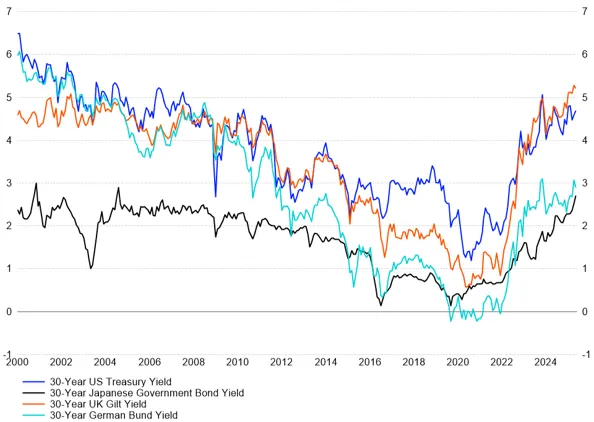
Long-term government bond yields

Picture28

Source: LSEG Workspace.

The bill also has the potential to stoke inflation further as provisions such as extended tax cuts, increased deductions, and new spending measures may boost consumer demand and government outlays. At the same time, tariffs and efforts to reshore manufacturing could constrain supply and drive up costs in the longer term.

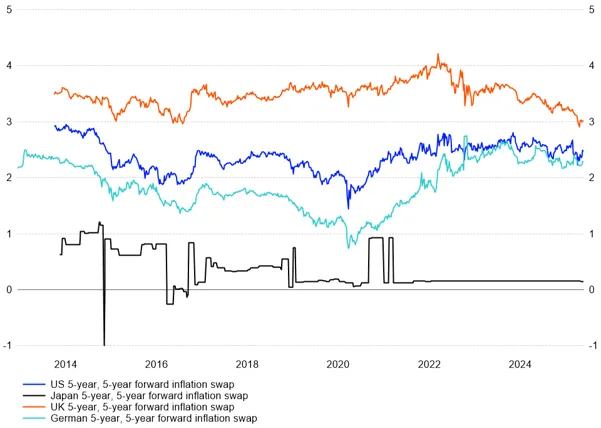
For now, however, the recent rise in long-term government bond yields across major economies appears less driven by fears of runaway inflation and more by mounting concerns over fiscal sustainability and a rising term premium. At present, the bond market’s inflation expectations remain steady.

Inflation Expectations: 5y5y Forwards

Picture29

Source: LSEG Workspace.

Spending pressures exist in many other western economies and with governments issuing more debt to finance such policies, markets are demanding higher yields to compensate for the increased supply and the perceived risk that fiscal discipline may be eroding.

At the same time, the term premium - the extra yield investors require for holding long-dated bonds in an uncertain environment - has risen as buyers seek greater compensation for risks related to policy unpredictability, geopolitical tensions, and shifting global capital flows. This marks the significant shift in the global bond market that has come about over the last couple of years or so, where investors are no longer willing to accept historically low yields in the face of growing fiscal and structural uncertainties.

On the US tariff front, the week ended with a sudden threat by the US to impose a 50% tariff on all European Union imports. This sent a brief shockwave through financial markets and raised the risk of a major transatlantic trade conflict. Although the measure was quickly postponed following talks with European leaders, the episode underscored the unpredictability of US trade policy and the fragility of economic relations.

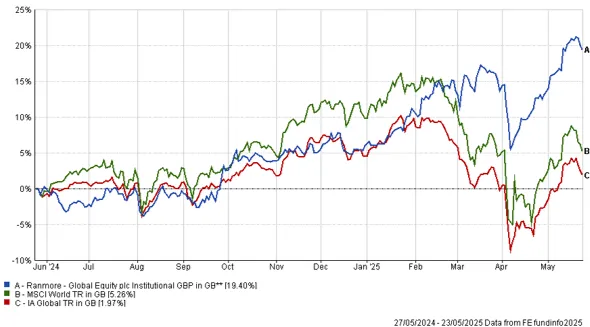
This week we caught up with Sean Peche, manager of the Ranmore Global Equity Fund held within each of the T. Bailey funds of funds portfolios. This fund has demonstrated resilience and agility through the current volatile economic environment, comfortably outperforming global equity benchmarks.

Ranmore Global Equity Fund: 1 Year Performance

Picture1

Source: FE Analytics. Total return, GBP terms.

Sean maintains a disciplined, value-driven approach that seeks out undervalued stocks globally, often capitalising on market overreactions and sentiment swings. This strategy has allowed the fund to benefit from recent volatility, with notable successes such as rapid gains in Foot Locker and active rotation into companies like EasyJet and Tesco, which were unfairly punished by broader market fears.

The portfolio is diversified across regions whilst maintaining a healthy cash position to seize new opportunities as they arise. A standout attribute of the fund is its focus on asymmetry: accepting that losing positions are an inevitable part of investing but ensuring the risks taken can lead to winning positions that generate returns several times larger than losses. The fund’s ability to adapt quickly, avoid crowded trades, and exploit inefficiencies - whilst keeping costs competitive and remaining operationally focused - positions it as an attractive option for the T. Bailey funds of funds portfolios.

Back to All Articles