T. Bailey Asset Management Limited do not provide advice to private individuals.

The information contained on this website is intended to provide information about our products and services and is not intended as investment advice. It is important that you do not rely upon its content to make investment decisions without seeking independent advice.

This website is intended for United Kingdom professional investors and advisers only. Please ensure you read the important legal information.

25 August 2025: Weekly Update – Intel, Market Leadership and Concentration Risk

Weekly Update
Thematic Investing

Intel's experience provides a reminder that technology leadership can change rapidly, even for companies that once appeared unassailable.

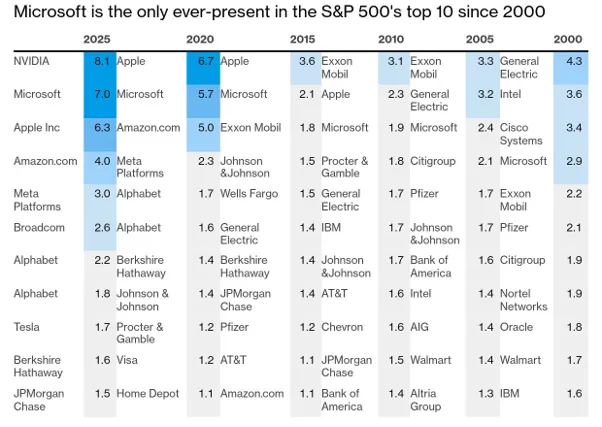
At the turn of the millennium, Intel stood as one of the world’s most celebrated companies. For a brief moment in 2000, it was the second-largest globally, a pioneer in microprocessor innovation and a symbol of the tech-driven future.

S&P 500 top 10 companies since 2000

Picture3

Source: Bloomberg. Percentage weighting as of 15 August each year. Alphabet appears twice due to its listing structure.

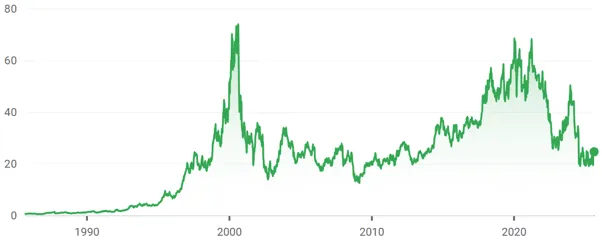
But the story since then has been sobering. Intel’s share price peaked during the TMT bubble and never returned. While once the leader in semiconductors, it has been overtaken by rivals like Nvidia and AMD, whose architectures now power the surge in AI and high-performance computing. Today, Intel is struggling to engineer a turnaround - one that requires flawless execution and heavy reliance on US government support, including a recent US$8.9 billion package effectively giving Washington a 10% equity stake.

Intel Share Price History (USD)

Picture4

Source: Google Finance.

For investors, Intel’s decline offers a cautionary tale. Market darlings can fall from grace, even those that seem unassailable in their era. Of the companies that dominated global markets 25 years ago, only Microsoft has managed to remain in the top 10 today. The rest, for now, have been replaced by a new generation of mega-cap tech leaders - the so-called Magnificent 7: Apple, Microsoft, Nvidia, Alphabet, Amazon, Meta, and Tesla.

Their current dominance reflects extraordinary business models and technological leadership. But history shows that technology leadership is rarely permanent. Disruption, changing demand, or policy shifts can upend competitive positions far faster than investors expect.

Intel’s trajectory is a reminder that today’s winners carry their own execution and concentration risks. The question for investors isn’t whether the Magnificent 7 deserve their current dominance but how much risk comes from assuming their positions will remain unchallenged.
Back to All Articles