T. Bailey Asset Management Limited do not provide advice to private individuals.

The information contained on this website is intended to provide information about our products and services and is not intended as investment advice. It is important that you do not rely upon its content to make investment decisions without seeking independent advice.

This website is intended for United Kingdom professional investors and advisers only. Please ensure you read the important legal information.

26 January 2026: Weekly Update – Multipolar Investing and Geographic Diversification

Weekly Update
Portfolio Construction Multi-Asset Investing Market Commentary

Mark Carney’s Davos speech provides a timely framework for considering geographic concentration, as recent data suggests portfolios with lower sensitivity to US equities have begun to outperform their more US-dependent peers.

At last week’s World Economic Forum in Davos, most of the attention inevitably went to US President Donald Trump. But in a speech delivered on 20 January (here*) Canada’s Prime Minister Mark Carney set out a more consequential clear and sobering view of the world economy. His argument was simple and precise: tariffs are leverage, supply chains are coercion, and great powers have stopped pretending that economic integration serves mutual benefit. For investors, this is not abstract geopolitics but a call to fundamentally redesign how we think about geographic concentration, currency risk, and the assumption of permanent US market dominance.

What makes Carney’s remarks particularly relevant for UK investors is how starkly they contrast with the way many multi-asset portfolios are positioned. Whilst Carney was articulating the case for strategic diversification and reduced US concentration, a simple analysis of typical investor portfolios - using the IA Mixed Investment 20–60% Shares sector as a lens - provides a troubling picture of how the industry is positioned. When we examine the distribution of such portfolios’ beta to the S&P 500 index (i.e. the US market) over time, we see very little strategic movement. Funds that carried high US beta two years ago still carry high US beta today. Those positioned with lower correlation haven't materially shifted their posture either. Funds that carried high US beta two years ago largely still do; those with lower beta remain unchanged. The sector has drifted with market conditions, but there is little evidence of deliberate, strategic repositioning.
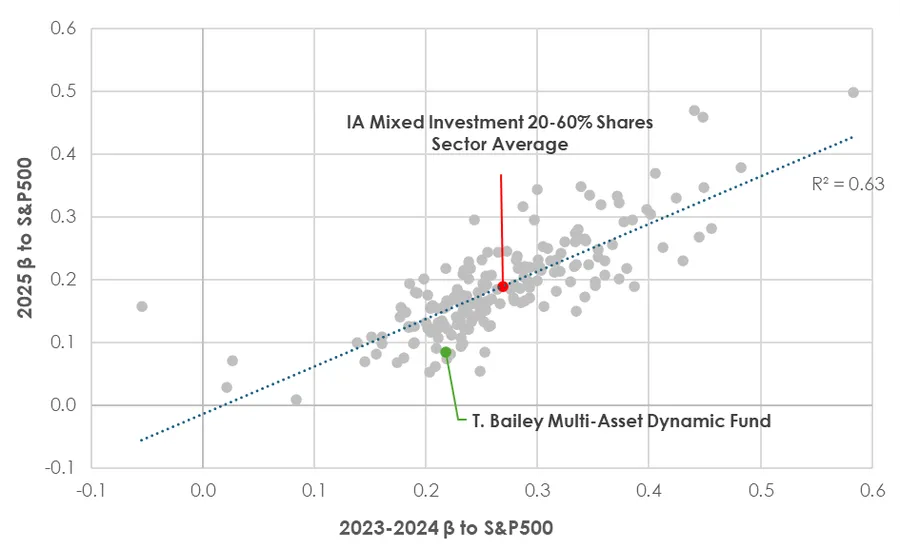
IA Mixed Investment 20–60% Shares Sector: Distribution of S&P 500 Beta Over Time

(2025 compared to the 2 years prior)

Picture1

Source: T. Bailey, LSEG Workspace. Based on weekly total returns in GBP terms to Friday 2 January 2026.

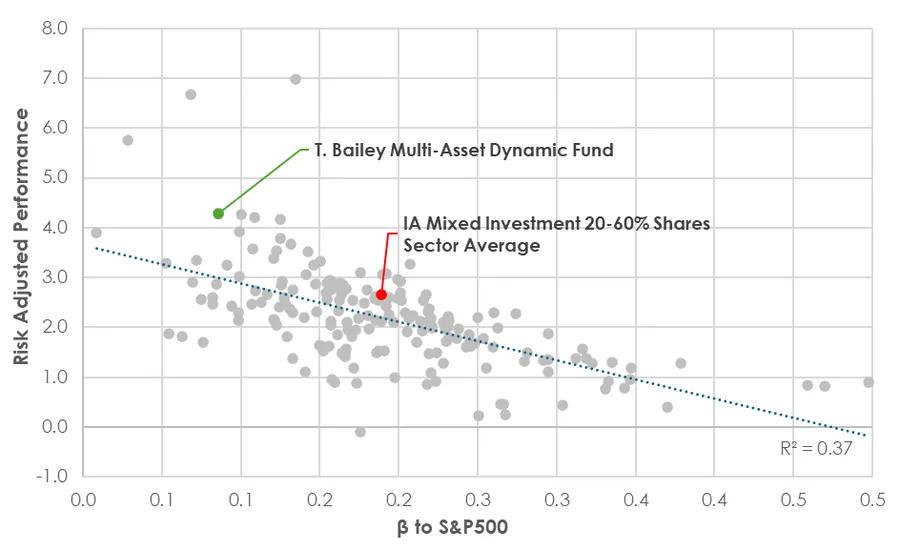
That inertia would matter less if markets were still rewarding concentration in the same way they did over the past decade - but they are not. Over the last twelve months, a clear pattern has emerged within the same IA sector: funds with lower beta to the S&P 500 have outperformed those with higher US sensitivity. This is not a forecast about what might happen in a more fragmented, multipolar world, but is evidence of what is already happening. The assumption that heavy US financial market exposure is the safest default is quietly being challenged by real-world performance outcomes.

12 Month Risk-Adjusted Performance of the IA Mixed Investment 20–60% Shares vs S&P 500 Beta

Picture2

Source: T. Bailey, LSEG Workspace. Average annualised weekly performance per unit of volatility. Based on weekly total returns in GBP terms to Friday 2 January 2026.

Taken together, these two charts present a clear picture: The first highlights an industry that has largely stood still, constrained by benchmarks and convention. The second shows that the market has already begun to reward those who move earlier. This is exactly the environment Carney was describing. When economic integration becomes a source of vulnerability rather than stability, concentration risk becomes a practical concern. Geographic diversification, reduced mega-cap dominance and exposure to resilient, investing economies move from being long-term ideas to near-term drivers of returns.

This backdrop naturally favours investment approaches that are not tightly bound to global cap-weighted benchmarks. At T. Bailey, our Multi-Asset Dynamic, Multi-Asset Growth and Global Thematic Equity strategies are designed with that flexibility in mind. The aim is not to make short-term calls on the US, but to protect and grow capital in real terms across changing regimes. That means the freedom to rebalance geographically, to manage name and sector concentration actively, and to maintain exposure to real assets and economies focused on resilience. Carney’s speech provided the intellectual framework for this shift, and the IA data suggests markets are already endorsing it. For investors deciding whether to act now or wait for wider consensus, the message from performance is becoming harder to ignore: those who have already adjusted are ahead, and the cost of waiting is rising.

Back to All Articles