T. Bailey Asset Management Limited do not provide advice to private individuals.

The information contained on this website is intended to provide information about our products and services and is not intended as investment advice. It is important that you do not rely upon its content to make investment decisions without seeking independent advice.

This website is intended for United Kingdom professional investors and advisers only. Please ensure you read the important legal information.

27 April 2026: Weekly Update – AI, Labour Arbitrage and the Future of Knowledge Work

Weekly Update
Global Equities

The accelerating adoption of AI is reshaping labour economics and forcing investors to reconsider the long-term sustainability of traditional software business models.

AI has been the dominant story of 2026, and the "pAIn trade" we wrote about in February has reshaped how the market prices software and platform businesses. Against that backdrop, we spent time this week with Xuesong Zhao, manager of the Polar Capital Artificial Intelligence Fund - a fund supported by the T. Bailey funds of funds since its launch in 2017. Zhao is among the more rigorous thinkers we encounter on this subject. His perspective reframed several of the debates that have dominated AI investing this year, and we thought it worth sharing.

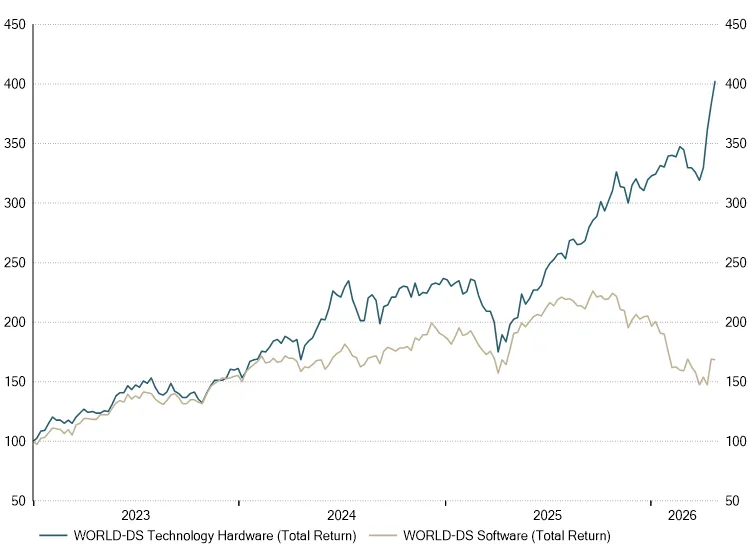
Technology Hardware versus Software

Picture10

Source: LSEG Datastream. Total return rebased to 100.

The misunderstanding that matters most concerns the addressable market for AI. For as long as the technology industry has existed, it has competed for a share of corporate IT budgets - estimated at roughly US$6 trillion per annum globally in 2026. AI is competing for something much larger: the global wage bill for knowledge workers, at approximately US$44 trillion. The implication is not that every dollar of that wage bill is immediately at risk; it is that the ceiling on the AI opportunity is of an entirely different order from anything the technology sector has previously addressed. Hyperscaler capital expenditure, which has unsettled investors accustomed to measuring technology spending against IT budgets, looks considerably less excessive when set against a prize of that size. Capital may yet prove to be poorly allocated, but the comparison sometimes drawn to the dot-com era - when fibre utilisation collapsed to 3% because the demand was simply absent - is not the right one. Compute utilisation is currently running at or above capacity, and its limiting constraint is power, not demand.

Enterprise adoption of AI has accelerated meaningfully over the past year, and the reason is less widely understood than it should be. Through 2024, benchmark scores for the most advanced AI models showed only marginal improvement in raw intelligence, which led many observers to conclude the technology had peaked. In fact, the industry's attention had shifted to reducing hallucination rates, achieved by redesigning models to reason step by step and verify conclusions before presenting them. For enterprise deployment, this matters considerably more than raw capability - a model that gives confident wrong answers is a liability whilst one that gives careful right answers becomes a tool. That shift drove the acceleration in AI revenues at the frontier model providers through the second half of 2025, and it is now beginning to appear downstream in the earnings of the companies deploying the technology.

The winners, in the Polar team's view, will be the minority that have spent years quietly preparing their data infrastructure - without which the technology simply cannot function. Zhao's preferred illustration is Delta Air Lines. Uniquely among major carriers, Delta operates a single integrated system spanning ticketing, customer data and airport operations. That integration now underpins a dynamic pricing capability already visible in reported margins, and one that competitors with fragmented systems cannot replicate quickly.
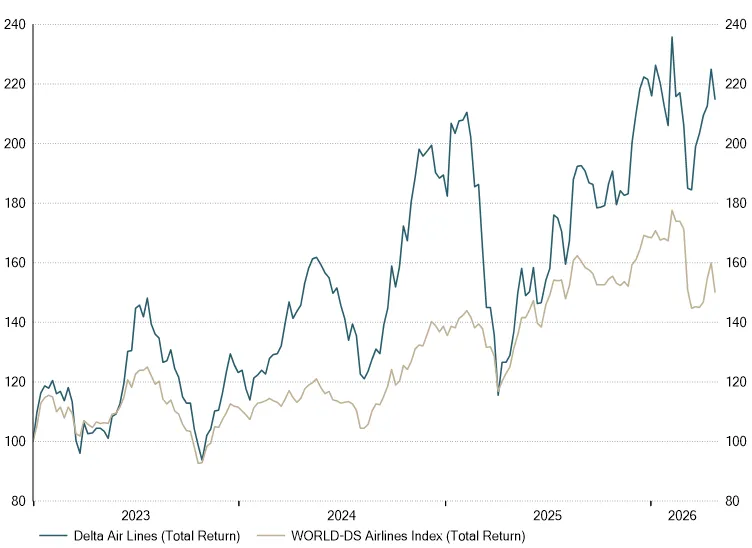
Delta Air Lines - Performance

Picture11

Source: LSEG Datastream. Total return rebased to 100.

Over the longer term, the disruption runs in two directions. On the constructive side, agentic AI - systems that initiate and complete tasks autonomously - is the first technology with a serious claim to overcome the human constraint of time. A company deploying effective agents does not hire more analysts to raise productivity; it buys more compute. On the destructive side, this is what makes seat-based software businesses, platform intermediaries and models built around human initiation of tasks so difficult to value. The concern is not that these businesses are heading to zero, but that their true earnings power in a world of agentic AI is unknown in a way that makes valuing them treacherous. These businesses will need to transition from seat-based to consumption-based pricing, but history offers only one clear example of an incumbent technology company navigating an equivalent shift: Microsoft's move from PC to cloud, which took five years and three chief executives to achieve.

Within the T. Bailey funds, the Polar Capital Artificial Intelligence Fund continues to earn its place because it approaches these questions with more patience and precision than markets tend to reward over short horizons. It has rotated towards the AI beneficiaries where earnings leverage is becoming tangible - physical asset owners, logistics operators and integrated franchises such as Delta - and away from the intermediaries and seat-based software businesses whose terminal economics remain genuinely uncertain. The near-term question is whether companies like Delta deliver the earnings improvements their AI investments imply. The longer-term one is which business models survive the transition, and how the market will value them. Both reward the patient, bottom-up analysis we believe the Polar Capital Artificial Intelligence Fund was designed to deliver.

Back to All Articles