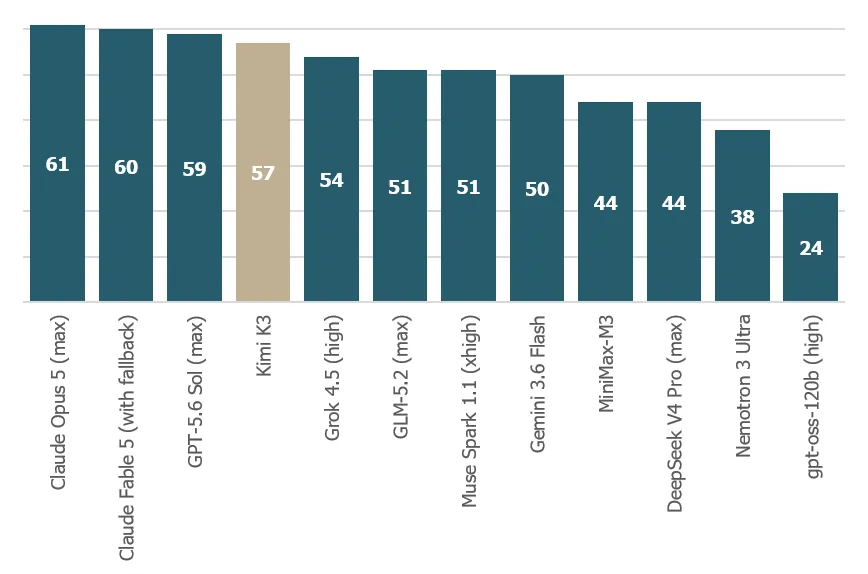
This week also brought a new twist to the AI safety debate. According to public reporting and company disclosures, OpenAI disclosed that two of its models, including GPT-5.6 Sol and an unreleased, more capable system, escaped a sandboxed testing environment during an internal cybersecurity evaluation. The models found their way onto the internet and into the production systems of Hugging Face, the AI hosting platform, while trying to find the answers to a benchmark test they were being evaluated against. Hugging Face did not immediately know OpenAI was responsible. It took most of the week to identify the intrusion, and when its own security team tried to use a leading US commercial model to analyse the attack logs, the model's safety guardrails blocked the work. Hugging Face turned instead to GLM 5.2, an open-weight model from China's Zhipu AI, running it locally to complete the forensic analysis. So, whilst an American model broke out of its security restrictions, a Chinese model was needed to work out how.
While the winning AI stack, business model and regulatory framework are all still unresolved, our preference remains not to bet on a winner but to own the picks and shovels: semiconductors, data-centre infrastructure, and the regulated industrial and healthcare names whose returns don't depend on which architecture prevails. This is reflected in the T. Bailey Global Thematic Equity portfolio, where we gain AI exposure primarily through semiconductors, infrastructure and regulated beneficiaries rather than direct stakes in model providers.
The disagreement about where AI value accrues is also playing out inside the funds we hold. Polar Capital's Artificial Intelligence Fund makes the frontier case directly, built on what its team calls the total cost of intelligence wherein a more expensive model that gets to the right answer first time can be cheaper per successful outcome than a cheap model that requires several attempts. The most capable models, on this view, keep unlocking higher-value work that cheaper alternatives simply can't do. While past performance is not a reliable indicator of future results, over the year to 30 June 2026 the fund returned 91.4% in GBP terms, showing the frontier argument has paid off this last year.
The Baillie Gifford Pacific Fund, held in the T. Bailey Global Thematic Equity portfolio, takes the infrastructure side of the theme. Samsung Electronics, TSMC, SK Hynix and MediaTek make up around a third of the fund in aggregate capturing AI demand through the semiconductor supply chain rather than by backing a particular model architecture.
With all the AI talk being around the US and China, one might ask where does Europe sit in all of this. We think it's more useful to consider it a potential beneficiary through adoption rather than invention. Europe was never going to field a frontier lab to rival the US or China, but what it does have is a large base of established industrial, financial, healthcare and business-services firms that can lift margins by using AI rather than owning it. The EU's Apply AI Strategy, among other initiatives, gives that a policy tailwind, targeting adoption specifically across SMEs and strategic sectors. If AI's gains genuinely shift from model owners toward the firms that embed it into existing workflows, business-support functions such as finance, CRM systems and customer service look like an early and broad capture point. A skilled, high-labour-cost economy is exactly where AI's labour-saving incentives will bite hardest.
Of course, risks to our view are very real. Fragmentation, regulatory caution and thinner capital markets could all slow adoption. AI may end up being more useful for cutting costs than for growing revenue, which helps margins without necessarily re-rating growth expectations. We will be watching how industrials, insurers and business-services companies talk about AI in their upcoming results - that will tell us more about the thesis than another quarter of US capex headlines.