However, Nvidia’s business model now extends well beyond making chips. In the last week it has taken a material step forward in the role of financier to the AI boom, reportedly committing up to US$100 billion to OpenAI, the company behind ChatGPT, with the capital earmarked to purchase Nvidia’s own hardware. On paper, this secures years of revenue. In reality, it ties growth to OpenAI’s solvency. OpenAI is not expected to turn cash-flow positive before 2029, despite forecasts of US$125 billion in revenue by then. A number of similar, albeit smaller, deals have been struck and remain untested. Should AI spending slow, the knock-on effect for Nvidia - and therefore global equity indices - could be severe.
History offers some warnings in this regard. Telecom suppliers in the late 1990s and General Electric in the 2000s both used vendor financing to accelerate growth, only to find their fortunes unravel when customers defaulted. Supplier-financed booms can magnify returns in good times but leave firms overexposed when cycles turn.
Other risks loom too. Nvidia’s largest customers - Google, Amazon, Microsoft, Meta - are investing in their own AI chips, which may erode Nvidia’s pricing power over time. Export restrictions on advanced chips to China also underline the geopolitical fragility of the model. Furthermore, AI hardware also faces rapid technological obsolescence risk, with each new generation of chips potentially rendering prior investment obsolete far faster than traditional capital cycles.
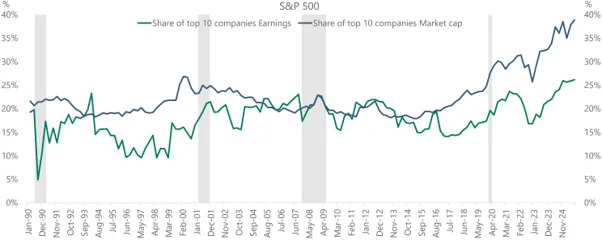
None of this negates Nvidia’s current technological lead or the transformational impact of AI. But with equity market concentration at historic highs, and market expectations assuming seamless growth, we see prudence here as essential.
Our exposures to Nvidia remain modest: 0.4% in the T. Bailey Global Thematic Equity Fund (1.61% in the Mag-7), 0.25% in the T. Bailey Multi-Asset Growth Fund (1.03% in the Mag-7), and 0.16% in the T. Bailey Multi-Asset Dynamic Fund (0.74% in the Mag-7). We are presently trimming exposure further, largely through the Polar Capital Artificial Intelligence Fund. While the Polar team highlight that leadership is shifting from hyperscalers to the broader beneficiaries of AI, we believe it is sensible to take a disciplined approach in what has become an increasingly crowded corner of the equity market.
By keeping exposures modest and carefully managed, we aim to capture the opportunities AI creates while protecting portfolios from the risks of excess enthusiasm.