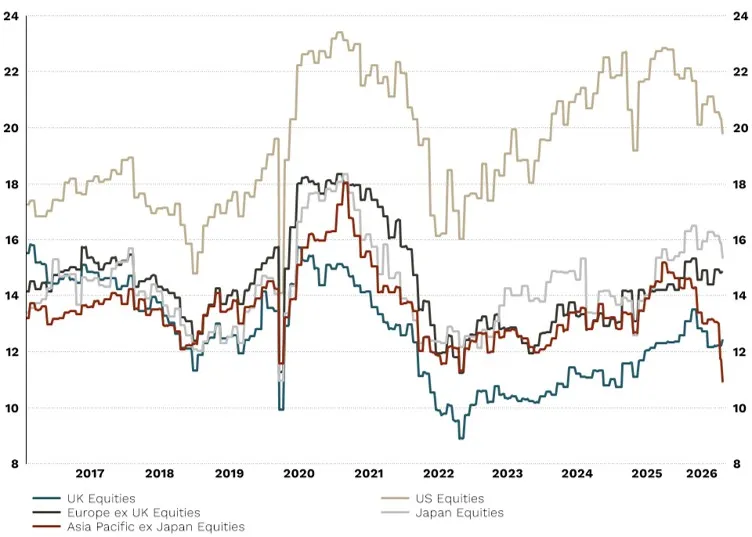
What gets lost in all of this is that “the UK economy” and “the UK stock market” are not the same thing. A great many companies listed on the London Stock Exchange earn most of their money somewhere other than the UK, or at least sell to companies that do. Their revenues are set by construction activity in North America, by corporate technology budgets in Germany, by hiring in the United States and Japan. What may happen with the Ofgem cap in October is, for these businesses, close to irrelevant. Nonetheless, they are priced daily off a domestic narrative, by top‑down asset allocators and investors who have decided that a London listing is a statement about a company’s prospects rather than simply a fact about where its shares happen to be registered.
Fortunately, that gap has begun to close this year, and through two factors at once. Below we discuss companies held in the T. Bailey UK Responsibly Invested Equity Fund that provide illustration.
The first factor is straightforward continued operational delivery. Keller, which constructs the foundations that large construction projects sit on, upgraded full‑year guidance materially ahead of consensus. Around 60% of its revenue comes from North America, and the driver was infrastructure and data centre work. Computacenter, which supplies and manages the technology that large organisations run on, guided first‑half profit to roughly double last year’s £81.5 million on hyperscaler demand in the United States. SThree, which places specialist engineers, scientists and technologists into contract and permanent roles, reported a half‑year in which profit actually fell, and yet its shares rose sharply, because US net fees grew 12% on energy infrastructure, data centre construction and AI‑related hiring, and because its contractor order book returned to growth.
Man Group, the investment manager, reported just this week with record assets of US$253.6 billion and performance fees of US$207 million against US$67 million a year earlier, earned from a global client base. 4imprint, which sells branded promotional merchandise, is to all intents a North American business that happens to file its accounts in sterling.
These five companies, cover construction, technology, staffing, fund management and marketing. What they have in common is not an industry but a geographical fact: none of them require a pick‑up in UK GDP in order to prosper, and yet for several years the market has priced them as though they did.
The second factor is that private capital buyers appear to have reached this same conclusion. Zurich, the Swiss insurance group, agreed terms for the Lloyd’s of London specialist insurer Beazley in February at up to 1,335p a share, close to 60% above the undisturbed price. EQT, the Swedish private equity group, reached agreement in June on Intertek, which tests, inspects and certifies products and supply chains worldwide, at £60 a share in cash plus the final dividend, valuing it at around £9.3 billion. And in July, ABB, the Swiss‑Swedish automation and electrification group, agreed to acquire Rotork for just over 500p per share in cash, valuing the Bath‑based maker of the electric actuators at roughly £4.1 billion, a premium of over 60% to the previous evening’s close.
Across the market, announced takeovers of UK‑listed companies reached something like £39 billion by the middle of this year, already ahead of the whole of 2025, at an average premium near 45%.
The last few years have been an awkward period in which to hold high‑quality, cash‑generative, well‑run companies at sensible valuations, because the market focused on a small number of very large businesses instead. However, patience with this approach has started to yield results.
When ABB set out why it wanted to acquire Rotork, it pointed to execution, engineering quality and customer trust. Those are precisely the characteristics we spend our time trying to identify in advance: pricing power that survives a downturn, customer relationships measured in decades, governance that produces no surprises, and profits that convert reliably into cash.
We would rather, though, that such recognition arrived without the company having to leave the market altogether. Beazley, Intertek and Rotork are three good businesses on their way out of London, and in time the proceeds will need redeploying into a market that contains three fewer candidates than it did at the start of the year. The Keller outcome is the better one by some distance: the same value recognised by the market, and we still own the business.
Not every holding has worked this year. Experian, the credit data and analytics group, has fallen despite reporting some of the strongest results in its history, with revenue up 12% to US$8.45 billion in the year to March, operating profit up 15% and a US$1 billion buyback announced alongside. Its shares de‑rated anyway, on the fear that artificial intelligence will eventually let lenders assess credit risk without reference to a bureau. Experian’s advantage rests on decades of proprietary data gathered under regulatory permissions that are not easily replicated.
Halma, which owns a collection of niche businesses in safety, environmental and healthcare technology, fell sharply in June after guiding to low double‑digit organic growth for the current year, having delivered 16.6% in the year just ended. That year was its twenty‑third consecutive year of profit growth, with record revenue of £2.58 billion, adjusted operating profit up 22% and cash conversion of 93%. A good company marked down for guiding conservatively after an exceptional year.
There is a neat irony in these examples too. Halma’s fastest‑growing division supplies photonics into data centres, the very construction boom that has lifted Keller and Computacenter. Experian’s difficulty is a fear about what the same technology will eventually do to demand for its services. One technology cycle is simultaneously the largest tailwind and the largest perceived threat across the portfolio, which is a reasonable argument for owning a spread of genuinely good businesses rather than a single view of the future.
What has changed is not the UK economy. It is that the distance between what these businesses are worth and what the market will pay for them is finally being recognised and closed. For our funds of funds, this reinforces two long‑held beliefs: that maintaining exposure to unfashionable but undervalued markets like the UK is essential for when leadership rotates, and that responsible, valuation‑disciplined stockpicking can add meaningfully to outcomes.
Either way, our work on the T. Bailey UK Responsibly Invested Equity Fund is unchanged: look for genuinely good businesses, buy them at a sensible price, and be patient enough to still be holding them when everybody else works it out.