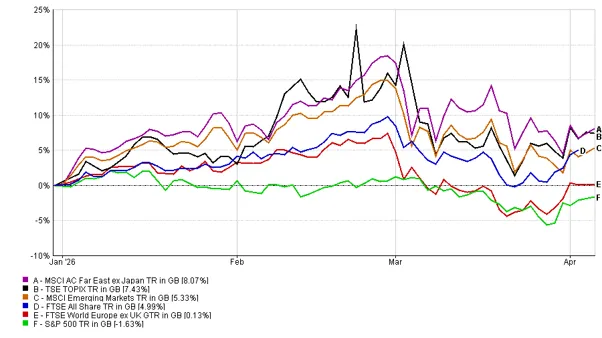
Persistent inflation and slowing growth revived stagflation concerns, though today’s environment differs significantly from the demand-driven inflation shock of 2022.
"Stagflation" is back in the headlines, and with it comes an understandable instinct to reach for what worked in 2022 - sell bonds, sell growth stocks, brace for rate hikes. Brent crude has pushed above US$110 a barrel, the OECD has delivered the largest growth downgrade to any G20 economy for the UK- cutting its 2026 forecast to just 0.7% whilst raising its inflation projection to 4% - and just over half of professional asset allocators in the latest Bank of America Global Fund Manager Survey expect stagflation as their base case over the coming twelve months. However, this is a likely misdiagnosis with risks that matter considerably for how portfolios should be positioned.
The 2022 inflation shock had specific characteristics worth remembering. In particular, whilst prices were accelerating at their fastest pace in forty years, it was against a backdrop of resilient demand as households drew down pandemic savings and corporate balance sheets had refinanced at near-zero rates. Central banks were so far behind the curve that markets were forced to price in a steep and rapid tightening cycle almost overnight. In those circumstances, aggressive monetary tightening was the correct response. What is happening now is structurally different. Inflation is persisting rather than accelerating, and it is doing so against a global economy with already fragile demand. In the UK, households face mortgage rates above 5%, energy bills set to rise sharply again in July, and food prices - sensitive to oil and fertiliser costs - are set to increase. In this environment, the same tightening response that was appropriate in 2022 would not cool inflation insomuch as it would amplify a growth shock. Thus, the Bank of England's hawkish hold on interest rates in March at 3.75% is less a validation of a repeat of 2022 than a reminder of the genuinely uncomfortable position its Monetary Policy Committee is in, being unable to cut without appearing to capitulate to inflation and unable to tighten without pushing an already weakening economy into something worse.
That matters for assets with duration. An environment of slowing growth and peaking inflation is one in which longer-dated bonds are not obviously the enemy they were three years ago. In 2022, rising yields reflected central banks catching up with an overheating economy, yet today’s inflation is largely a supply-side import, arriving into an economy where domestic demand is already under pressure. If growth disappoints materially, which the OECD's revised forecasts suggest is a meaningful risk, rate expectations will have to fall back, and with them yields. Duration is not without near-term risk, but holding some exposure to it is a considerably more defensible position than the 2022 playbook would suggest.
The broader case for remaining invested in diversified assets was illustrated at the end of March. On the 31st, having fallen sharply through the month as the conflict in the Gulf intensified, equity markets suddenly surged with the S&P 500 recording its best single session in nearly a year as US President Trump signalled a willingness to end the military campaign and Iran's president expressed what was described as the "necessary will" for peace. Asian and European markets continued higher the following day. The oil price rebounded above US$108 shortly thereafter as rhetoric hardened again, and the apparent off-ramp proved narrower than the initial optimism suggested. But the episode made the point clearly: attempting to time a re-entry to financial markets following a geopolitical crisis is rarely successful, and the cost of being absent from markets in the moments that matter compounds quickly. Remaining invested through such volatility is not complacency; in most cycles it is simply the right course of action.