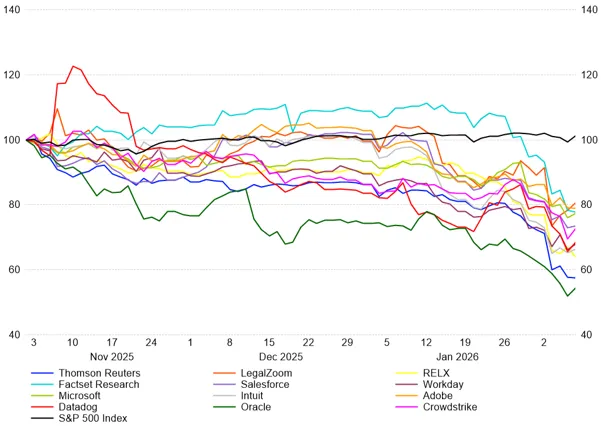
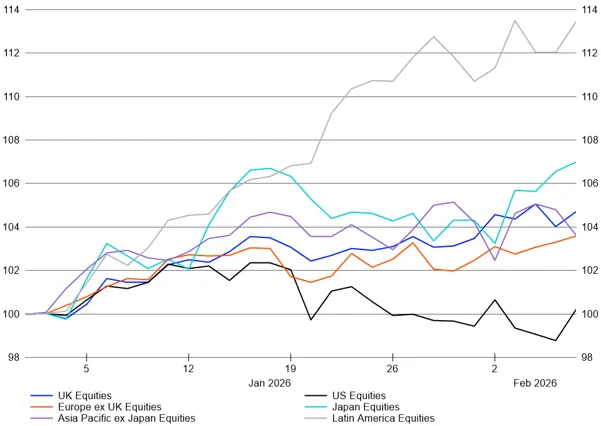
A sharp market rotation away from growth and software stocks highlighted rising concerns around AI disruption and concentrated US technology exposure.
This was a week light on the kind of heavyweight economic data that usually dominates the diary. But what it lacked in macro releases, it more than made up for in market drama through a sharp sell-off in technology driven equities that ran from Tuesday through Thursday. This was not about weakening earnings or deteriorating balance sheets, but instead reflected a sudden and somewhat ruthless reassessment of AI disruption risk, which quickly morphed into a broad-based and, at times, indiscriminate sell-off across growth and enterprise software stocks.
The catalyst was Anthropic’s launch of industry-specific plugins for its Claude Cowork tool, its AI workplace assistant capable of handling complex, multi-step workflows. Markets reacted swiftly, particularly in areas where business models rely on routine, document-heavy processes.
The legal sector provides clear examples. Claude Cowork’s legal plugins directly target many of the workflows that underpin the economics of businesses such as LegalZoom and RELX. For LegalZoom, a self-service platform built around standardised contracts, NDAs, and basic compliance tasks, the risk is that AI assistants can now deliver similar outcomes inside a general-purpose workspace and potentially erode the value of templated forms and “do-it-yourself” guidance. For RELX, whose LexisNexis franchise monetises legal research and analytics on a per-seat subscription basis, the concern is a gradual “unbundling” of that business model, as AI-driven search, summarisation, and retrieval migrate into everyday productivity tools across the legal profession. The market response was swift, with both stocks suffering double-digit declines as investors reassessed whether foundation model providers will remain neutral infrastructure or evolve into full-stack competitors.