T. Bailey Asset Management Limited do not provide advice to private individuals.

The information contained on this website is intended to provide information about our products and services and is not intended as investment advice. It is important that you do not rely upon its content to make investment decisions without seeking independent advice.

This website is intended for United Kingdom professional investors and advisers only. Please ensure you read the important legal information.

9 March 2026: Weekly Update – Hormuz Closure, Energy Shock and Inflation Risks

Weekly Update
Economic Outlook

The effective closure of the Strait of Hormuz caused severe disruption across energy markets and raised stagflation risks for major global economies.

The situation in brief

It has been a grim week. US and Israeli forces launched coordinated strikes against Iran on 28 February, moving quickly to decapitate the regime's leadership and suppress its air defences before targeting missile production facilities and broader military infrastructure. Iran's retaliation has been chaotic and deliberately wide, striking not just US and Israeli assets but Gulf neighbours - Saudi Arabia, Kuwait, Bahrain, Qatar and the UAE - with oil facilities and civilian infrastructure caught in the crossfire. The intent appears to be to widen the conflict as far as possible.

The most consequential development came when the Islamic Revolutionary Guard Corps declared the Strait of Hormuz closed. Shipping through the Strait, which in normal times carries roughly a fifth of global seaborne oil and a substantial share of LNG flows, has effectively stopped. Qatar has shut down LNG output entirely, warning that restoring production will take weeks even once a decision to resume is made. Iraq has been forced to shut in around 1.5 million barrels per day as regional storage fills. The situation remains fluid and we are acutely conscious that behind the market moves lies enormous human suffering.

Energy and commodity markets

The market response has been dramatic. Brent crude, which closed last week at around US$94 a barrel, pushed above US$100 this morning (9 March 2026) - roughly 50% higher than a month ago. European natural gas has been hit harder still: the Dutch TTF benchmark has surged above €61 per megawatt-hour, nearly double its level a fortnight ago and its largest weekly gain in years.

The oil futures curve has moved into steep backwardation - the steepest since Russia's invasion of Ukraine. That structure indicates the acute near-term tightness is being priced in, but the assumption embedded in longer-dated contracts is that the disruption proves temporary. In effect, the curve is pricing a binary outcome. Either the Strait reopens in the coming weeks and prices reverse sharply, or the closure drags on for months and oil above US$100 becomes the backdrop for the rest of 2026.
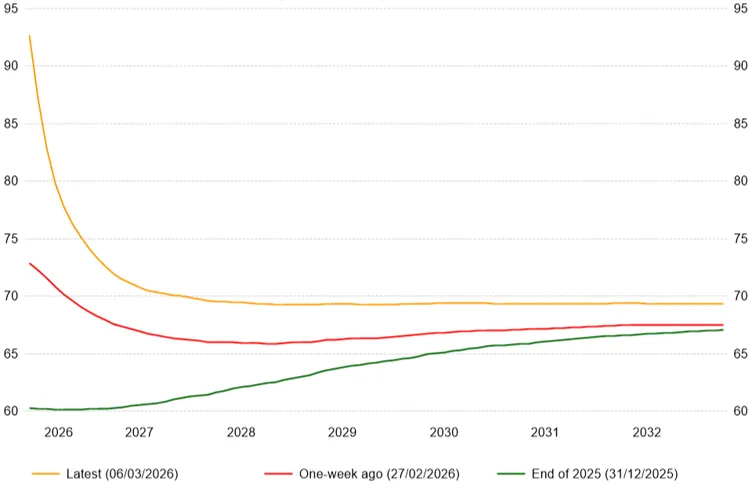
Oil Futures Contracts: ICE UK Brent futures, settlement price US$/bbl

Picture14

Source: LSEG Workspace. ICE UK Brent futures contracts settlement price, US dollars per barrel.

Across asset classes

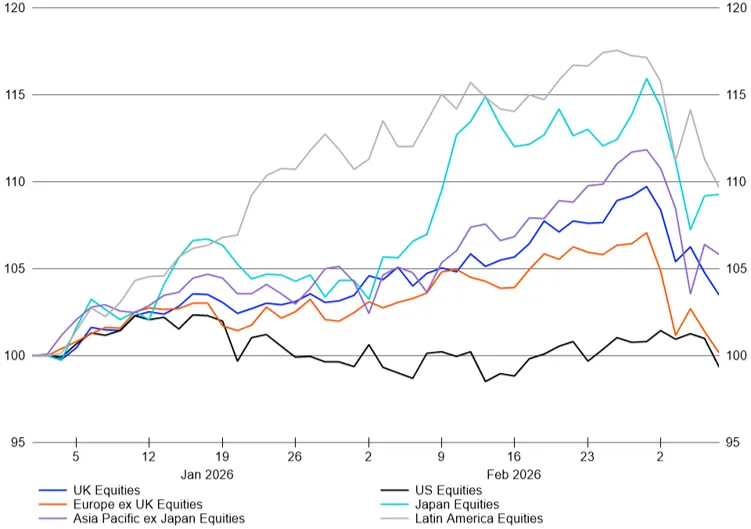
US equities have been relatively resilient. America's near self-sufficiency in oil insulates its economy from the worst of the supply shock, and that distinction is showing up clearly in relative market performance. The US dollar has strengthened markedly. Bond yields have risen rather than fallen, pointing to the inflationary shock. For energy-importing economies in Europe, Japan and much of Asia, the combination is stagflationary: higher inflation arriving alongside weaker growth. The US faces the inflationary impulse too, but with far less drag on output. That divergence is likely to widen if the disruption persists.

Regional Equity Markets: Year-to-date

Picture15

Source: LSEG Workspace. Total return, GBP terms. Rebased to 100 on 31 December 2025.

Positioning across the T. Bailey funds

Earlier this year we had been steadily reducing exposure to European and US equities while building a more positive view on emerging markets. In light of last week's developments, we have paused that direction of travel.

Our prior moves have had mixed results. We exited the holding in the L&G Europe ex UK Equity UCITS ETF entirely and also closed out the Amundi Prime Japan UCITS ETF, deploying that capital into emerging markets and thematic equities more broadly. Exiting two net energy-importing regions has helped at the margin, though the honest assessment is that holding more energy assets would have served investors better over the past week. Our emerging market addition has added at the margin to near-term headwinds, given the region's sensitivity to energy import costs and a stronger dollar. That said, overall, our EM exposure sits predominantly with an active manager, a distinction we feel matters even more now than it did a month ago.

Within equities more broadly, our thematic allocations to healthcare and to value-oriented strategies have provided some cushion. Healthcare demand is largely non-discretionary and well-insulated from energy costs. Value strategies (such as the WS Havelock Global Select and Ranmore Global Equity funds) have historically fared better when discount rates rise and expensive growth stocks are de-rated - which is precisely the environment an inflationary energy shock creates.

Away from equities, the funds' non-equity holdings continue to play their part. Commodity allocations - gold and copper - have been helped by the tailwind of dollar pricing combined with a dollar that has strengthened sharply. Absolute return strategies within the portfolios have lower market exposure, a valuable characteristic when the range of plausible outcomes is as wide as it is presently. In fixed income, our preference for short-to-medium dated bonds has been vindicated: these positions carry attractive running yields whilst avoiding the duration risk that punishes holders of longer-dated government debt as inflation expectations are revised higher. With the Bank of England now more likely to slow or defer rate cuts than to ease, keeping duration short remains the prudent course.

Overall, in a week when energy and commodity assets have surged, diversification has limited the impact rather than eliminate it entirely. We think the positioning of the T. Bailey portfolios remains reasonable for the medium term, and here it is worth stepping back from the immediate noise. Markets are currently focused on pricing in the negatives, of which there are plenty. But the oil futures curve itself, even as it prices acute near-term tightness, embeds the assumption that disruption is temporary. A year out, futures point to materially lower prices than today. History supports that view: supply shocks of this kind are painful but they do resolve. There is also a less-discussed possibility that is worth considering. If the strikes genuinely devastate Iran's nuclear capability and military infrastructure, the long-run implications for regional stability may be meaningfully positive. A Middle East with a diminished Iranian threat may, over time, attract investment, generate stronger growth with reduced risk - outcomes that would be broadly supportive for financial assets. The world has a strong tendency to return to normal, and in a year's time the picture may look quite different from today's.

Back to All Articles