Central banks held their ground
The Federal Reserve left rates at 3.50%-3.75% on 29 July albeit three of its twelve voters wanted an immediate quarter-point increase. The Bank of England similarly held at 3.75% the next day, by six votes to three.
Kevin Warsh, the recently appointed Fed Chair, had spent much of July trying to tighten financial conditions without lifting rates, informing Congress that the Fed had no tolerance for inflation remaining above target. Softer US inflation numbers provided some breathing space to repeat that message without having to act. However, his end-of-month press conference gave markets less clarity and short-dated Treasury yields fell after the decision while longer-dated yields rose. Investors took the combination to mean less chance of a near-term rate rise, but more concern about inflation and borrowing costs further out.
That may have been a deliberate strategy - a credible central bank can get part of the effect of a rate rise by making investors fear one. But a simpler explanation is that a new chair gave markets too little detail about what would make him act. Without a reference framework, investors were left to work out the path for themselves.
The T. Bailey multi-asset funds remain tilted towards bonds that mature sooner rather than later. The iShares $ Treasury Bond 7-10yr UCITS ETF holding fell 1.7% in July; the shorter-dated gilt holding fell 0.2%. Longer-dated bonds may offer more income, but they lose more when inflation or government borrowing pushes yields higher.
The UK economy is not the UK market
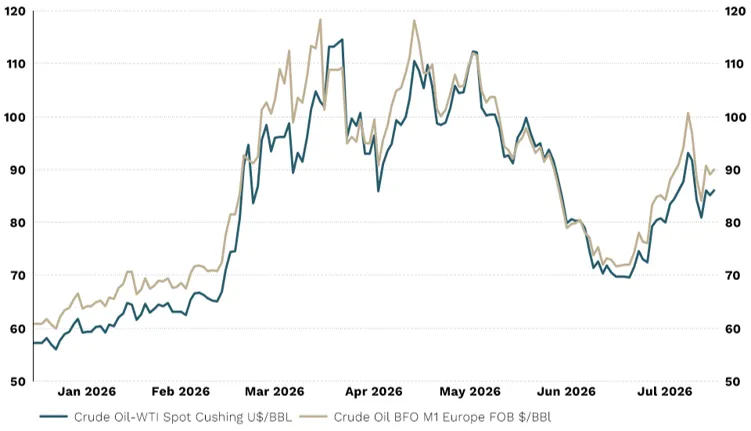
Andy Burnham became UK Prime Minister on 20 July, inheriting weak economic growth, rising household energy bills, and an inflation outlook that leaves the Bank of England little room to cut rates.
UK shares told a different story, with a strong performance in aggregate for the month. Among UK holdings in the T. Bailey UK Responsibly Invested Equity Fund, Keller upgraded its full-year guidance on North American infrastructure and data-centre work. Computacenter said it expected first-half profit to be around double last year's figure, on demand from US data-centre operators. SThree's US net fees grew on work in energy infrastructure, data-centre construction and AI-related hiring. Man Group reported record client assets of US$253.6bn and performance fees more than three times higher than a year earlier.
None of these companies needs a stronger British consumer to grow. They are listed in London, but their customers are elsewhere in the world.
Corporate buyers have been reaching a similar view of late. ABB agreed to buy Rotork for just over 500p per share in cash, valuing the Bath-based maker of electric actuators at around £4.1bn (more than 60% above the previous close).
We would rather the UK equity market recognised good businesses without taking them private or selling them to overseas buyers. Every takeover leaves one fewer company in London for investors to own.
How the portfolios fared
July was slightly negative for all three T. Bailey funds of funds. The falls were small compared with the moves inside the portfolios.
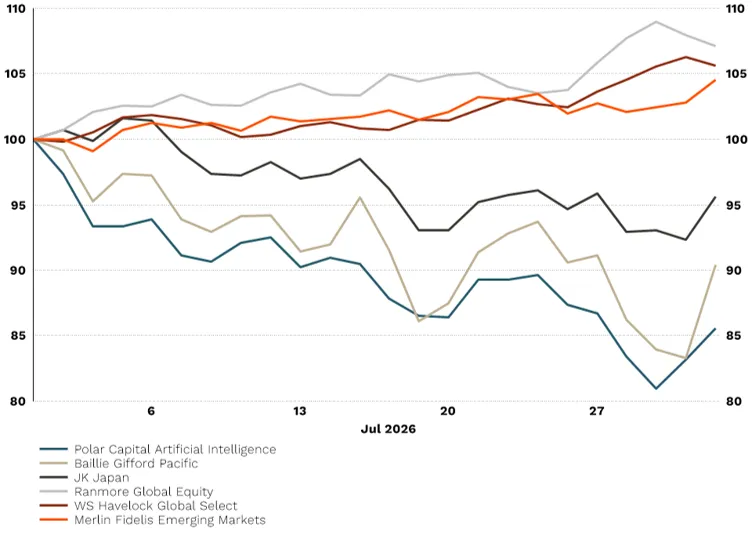
The Polar Capital Artificial Intelligence Fund fell 14.5% and was the largest detractor within each portfolio. Nonetheless, it has still returned 53.7% over twelve months. We had reduced the holding within the T. Bailey Global Thematic Equity and Multi-Asset Growth funds in Q2, which helped at the margin, but it did not mean we called the last week of the sell-off.
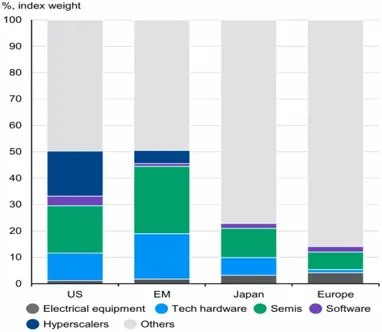
The Baillie Gifford Pacific Fund fell 9.6%. Samsung, TSMC, SK Hynix and MediaTek make up around a third of the fund, so the falls in Korea and Taiwan came straight through. The HSBC MSCI Emerging Markets ETF fell 7.4% for the same reason.
Other holdings did what they were there to do. Ranmore Global Equity returned 7.2% and was the largest contributor to all three portfolios. WS Havelock Global Select returned 5.7%. Polar Capital Global Insurance gained 2.3%. VT Gravis UK Infrastructure Income gained 3.5%. WisdomTree Copper gained 2.3%.
Merlin Fidelis Emerging Markets gained 4.6%, while the average emerging-market fund fell 4.7%. The manager owns less of the Asian chipmakers that dominate the benchmark which hurt in June, when those shares rose, but helped in July, when they fell.
Japan showed a similar pattern: the JK Japan Fund, which has a bias towards growth and technology companies, fell 4.4%, while WS Zennor Japan Equity Income rose 1.1%. Holding both in the T. Bailey portfolios is deliberate - they will not lead in the same market.