T. Bailey Asset Management Limited do not provide advice to private individuals.

The information contained on this website is intended to provide information about our products and services and is not intended as investment advice. It is important that you do not rely upon its content to make investment decisions without seeking independent advice.

This website is intended for United Kingdom professional investors and advisers only. Please ensure you read the important legal information.

June 2026 Market Review: The Ceasefire Trade, Food Inflation and AI Concentration

Monthly Report
Economic Outlook Market Commentary

Oil prices fell sharply and equity markets reached new highs during June, but beneath the surface investors continue to face inflation risks, fiscal pressures and unprecedented market concentration. The report explores why food inflation, healthcare valuations and diversification may become increasingly important themes in the second half of 2026.

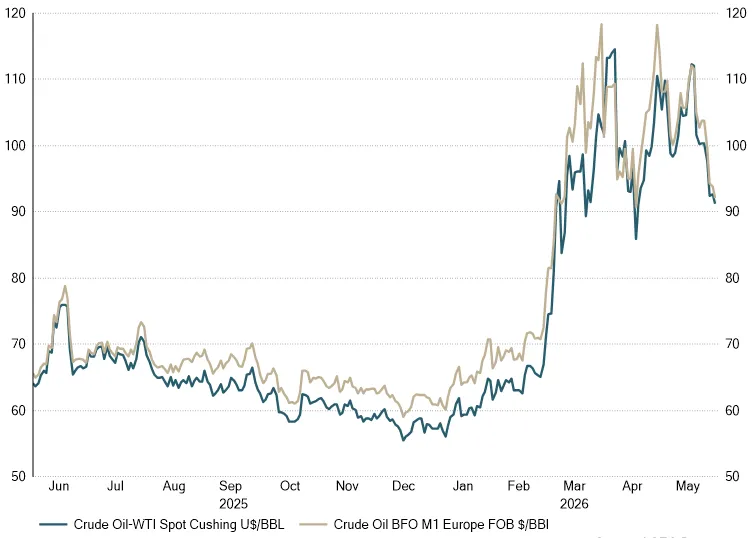
  • Oil's sharpest monthly fall since the pandemic: Brent crude fell almost 19% in May as US-Iran ceasefire talks raised the prospect of reopening the Strait of Hormuz, closing below US$93. The relief was real, yet so remains the gap to a resolution.
  • Equities reached record highs, for around a dozen reasons: The S&P 500 rose approximately 5% and closed at an all-time high. Just twelve companies accounted for roughly 12 percentage points of its combined April and May return of 16%. The equal-weighted index told a considerably less impressive story.
  • The handover from energy to food is already under way: Whilst the price of a barrel of oil is the story financial markets have been watching, the bushel is the one that will matter most over the next twelve months as the spring fertiliser window closes and the consequences of disrupted Gulf supply chains begin to arrive in supermarkets.
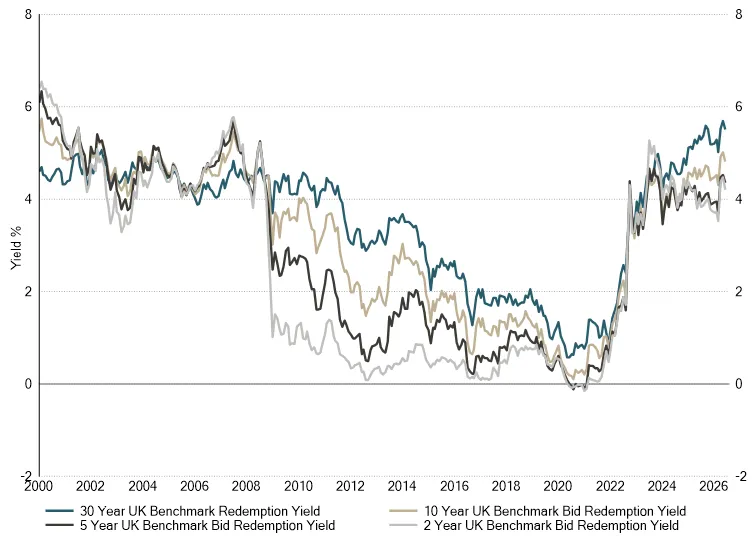
  • The UK political backdrop deteriorated sharply: Labour's heavy local-election losses and the Health Secretary's resignation pushed 30-year gilt yields briefly to levels last seen in the late 1990s, adding a political risk premium to what was already an uncomfortable inflation and growth mix.
  • AI earnings were extraordinary - and healthcare quietly had its most important month in years: Dell reported 88% revenue growth; Micron briefly crossed a US$1 trillion market capitalisation. At the ASCO annual meeting, the drug daraxonrasib received a standing ovation for doubling survival in pancreatic cancer. Yet the sector that produced it spent the month as a donor to the AI rotation.

Particular kinds of markets flatter investors and May was a case in point. Headline news items for the month - ceasefire talks to end the US-Iran war, falling oil prices, record equity highs - were each positive and accurate, and yet provide a misleading sense of security that there’s sufficient resolution to a conflict whose full economic consequences have not yet been felt. We think a more appropriate read is not that the crisis is over, but that its most visible symptom has seemingly begun to recede while the structural effects are only now moving through the system.

What a ceasefire does and does not change

Genuine, albeit tenuous, progress towards a ceasefire produced a legitimate relief rally in financial markets. But the physical damage to Gulf energy infrastructure will take quarters to repair, not weeks. The International Energy Agency (IEA) has highlighted the disruption as one of the most significant supply shocks in decades. Brent at around US$80 per barrel by the fourth quarter remains a plausible outcome and, while meaningfully lower than today, it is not a return to the world that preceded the start of war.

Oil Price, US$

Picture1

Source: LSEG Workspace.

The broader consequences are structural. For yet another time this decade - following Covid-19, Russia's invasion of Ukraine, the Red Sea closure, and the US tariff shock of 2025 - supply disruption has forced a comprehensive revision of assumptions about international trade, and energy in particular. The UAE is accelerating a pipeline to bypass the Strait of Hormuz; OPEC's internal architecture has shifted with the UAE's departure. Energy maps are being redrawn and the next equilibrium to be found will not be that of February’s.

The relay race

While the oil price has been the story financial markets have been watching closely in the first half of the year, the food channel is the one that will define the second half of 2026. The Strait of Hormuz is a chokepoint not only for crude and LNG but for global nitrogen fertiliser supply - the Gulf states are among the world's largest exporters of urea and ammonia, and the disruption forced manufacturers across South and Southeast Asia to curtail output through the entire spring planting window. At the same time, the emergence of a strong El Niño is tightening water and temperature constraints across many of the same cropping regions, turning what might, at best, have been a manageable input shock into a potential production shock. Those production decisions are made; their consequences, now compounded by weather, arrive in supermarkets from late 2026 into 2027.

The Bank of England has projected UK food inflation of 4.6% by September; industry bodies have since pointed to numbers sharply higher. However, the critical point is not the precise level but the timing. Energy's contribution to annual CPI will be fading through base effects over the very period when the food component is likely to be accelerating. That mechanical handover will flatter the headline inflation statistics at precisely the moment central banks might be tempted to claim the inflation battle won. A ceasefire that brings oil down will not have changed the coming harvest.

Food inflation is also stickier and more regressive than energy inflation: it takes a growing season to correct and falls hardest on those least able to absorb it. For the T. Bailey Multi-Asset funds we continue to hold short-to-medium dated bonds rather than reaching for duration, maintain real asset exposure through gold and copper, and retain equity exposure in areas with genuine pricing power.

The UK's uncomfortable arithmetic

The local election results in the first week of May added a political risk premium to the UK gilt market which was already under pressure from the energy-inflation impulse. The Bank of England is holding its base rate at 3.75%: it cannot cut without appearing to accommodate above-target inflation, and it cannot tighten without pushing a barely growing economy into recession. UK public borrowing in April was £24.3 billion, the second-highest on record for that month, and the flash composite PMI fell to 48.5 - the sharpest contraction in business activity in over a year. Much of the rise in long-dated gilt yields reflects higher inflation expectations rather than improved real returns; on a real-yield basis, the improvement is considerably more modest than the nominal numbers imply. We continue to hold short-dated UK government bonds and are not extending duration.

UK Conventional Gilt Yields – 2000-2026

Picture2

Source: LSEG Workspace.

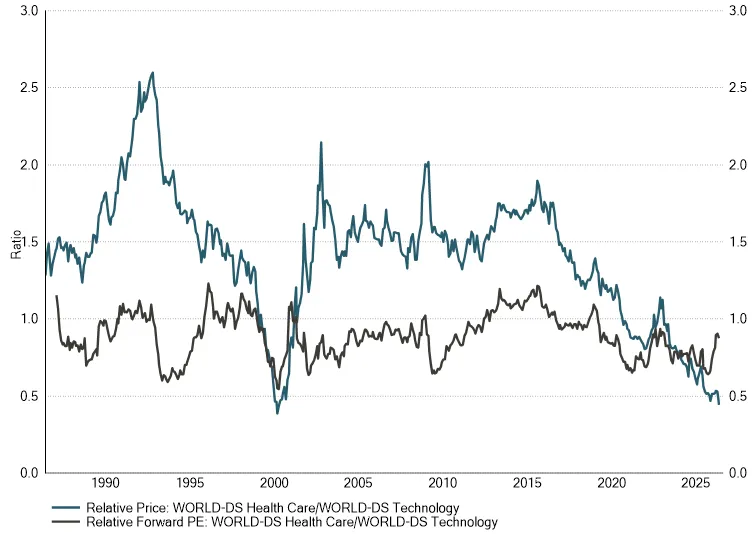
Mega-cap technology and the AI complex have continued to absorb capital with a momentum that has left little room for competing narratives. The funding for this rotation has had to come from somewhere, and healthcare has seemingly been among the most notable donors. On a pure price basis, the relative ratio of world healthcare to world technology is back to levels last seen at the peak of the dot-com bubble in 1999-2000 - a pattern that has historically been followed by material healthcare outperformance, and one reached only at moments of extreme dislocation.

Healthcare versus Technology: Relative Price and Forward Earnings

Picture3

Source: T. Bailey, LSEG Workspace. World-DS Health Care Index relative to World-DS Technology Index.

It would be easier to rationalise this if the underlying healthcare businesses were struggling, but they are not. The month closed with a sharp illustration of the disconnect between scientific achievement and market recognition. At the ASCO (American Society of Clinical Oncology) annual meeting in Chicago, the full data from testing of a new drug, daraxonrasib, in pancreatic cancer reportedly received a standing ovation from more than 9,000 oncologists. The drug doubled median overall survival compared with chemotherapy, from 6.7 months to 13.2 months, in a disease where meaningful progress has been elusive for decades. Alongside that, Novo Nordisk's oral Wegovy received European approval, and Bristol-Myers Squibb announced a collaboration with Jiangsu Hengrui covering thirteen programmes, with up to US$15.2 billion in potential milestones - one transaction in what is the most active pharmaceutical M&A environment in years. The case for our allocation to healthcare has not weakened during its relative share price underperformance. Bystanders to a boom rarely feel rewarded in the moment, but over the cycle, they often are.

Similar logic applies to other themes within the T. Bailey funds. For the Regnan Sustainable Water and Waste Fund, it is business as usual: steady margins, consistent cash flows, and quiet compounding. US industrial production and construction activity were both rising through the month - a direct volume catalyst for waste businesses. And there is a connection between the AI infrastructure build driving the equity market and the businesses inside this fund that the market has not yet begun to price: data centres are significant consumers of water, creating structural long-duration demand for businesses the market is currently content to ignore. Strong assets out of favour because attention has moved elsewhere. The AI trade requires the narrative to remain intact, sentiment to remain elevated, and earnings to continue surprising to the upside. The water and waste case requires only that the businesses continue doing what they have always done.

How the portfolios fared

The AI theme and Asian equities drove the month's positive results. The Polar Capital Artificial Intelligence Fund returned 10.9%, extending its twelve-month return to +98.0%; the First Trust NASDAQ Cybersecurity ETF returned an astounding +32.1%; and the Baillie Gifford Pacific Fund rose 15.4% as Samsung crossed the US$1 trillion market capitalisation on AI memory demand. The Lansdowne (Lux) Developed Markets and JK Japan funds were both strong performers. Following the strong run in each, we trimmed our positions in the Polar Capital Artificial Intelligence Fund (in the Global Thematic Equity and Multi-Asset Growth funds) and Baillie Gifford Pacific Fund (in the Global Thematic Equity Fund).

The Merlin Fidelis Emerging Markets Fund lagged - the mirror image of its outperformance in March, when the same deliberate underweighting of the AI hardware trade protected investors in a month of indiscriminate selling - its twelve-month return remains well ahead of its peer group. Among the diversifiers, gold gave back a little of its safe-haven premium and copper rose meaningfully on AI infrastructure demand and improving industrial activity. Chrysalis Investments fell sharply, adding to a frustrating run despite its wind-down structure being in place, Starling Bank's operational momentum remaining intact, and its shares sitting at a deep discount to net asset value.

Looking ahead

Our base case remains a gradual yet bumpy resolution of the Hormuz crisis. But a reopening of the Strait is only the beginning of normalisation and not the end of the disruption. Infrastructure rebuilds on a physical timeline; food prices follow a seasonal one; political systems adjust on their own terms, which are rarely convenient.

The equity market is extended: concentration is at historic extremes, the equity risk premium is close to zero, and a large wave of index-eligible supply - SpaceX, OpenAI, Anthropic - is about to land. The capital to absorb it will need to come from somewhere, and the most natural sources are the areas that are most crowded. Against that backdrop, assuming that strong growth themes continue unabated - and building portfolios as if they will - strikes us as unwise. The AI investment cycle is real and we maintain meaningful exposure to it, but the T. Bailey funds are constructed to generate returns across a range of outcomes, not to depend on any single narrative remaining intact. That means holding healthcare businesses generating genuine medical breakthroughs at historically cheap valuations; water and waste businesses compounding quietly through the noise; diversified emerging market exposure not reducible to the semiconductor trade; and real assets providing ballast against an inflation story that has further chapters to run. Our trimming of AI positions this month, following their exceptional run, reflects that discipline in practice.

Investment returns over a full cycle have rarely come from the most crowded part of any market. They have tended to come from the parts the market was too distracted to look at carefully, and that is where much of our attention is focused.
Back to All Articles