T. Bailey Asset Management Limited do not provide advice to private individuals.

The information contained on this website is intended to provide information about our products and services and is not intended as investment advice. It is important that you do not rely upon its content to make investment decisions without seeking independent advice.

This website is intended for United Kingdom professional investors and advisers only. Please ensure you read the important legal information.

May 2025 Market Review: Trade Policy Volatility, USD Weakness and Global Equity Rebound

Monthly Report
Market Commentary Global Equities Multi-Asset Investing

Trade tensions eased in May, supporting a recovery in global equity markets. A weaker US dollar and continued strength in gold reinforced the importance of diversification across asset classes.

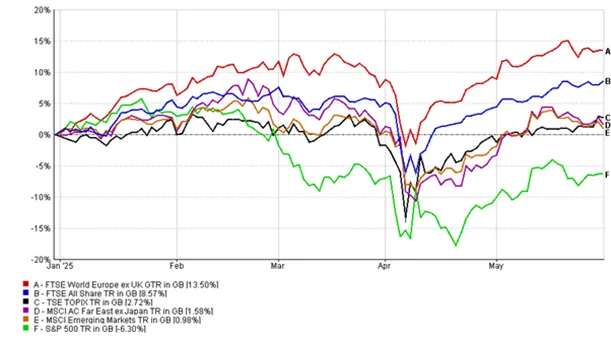
Following the turmoil that gripped markets in April, largely driven by the surprise imposition of US "Liberation Day" tariffs, May saw equity markets recover lost ground.

World Equity Market Returns Year-to-date (GBP Terms)

Performance chart

Source: FE Analytics.

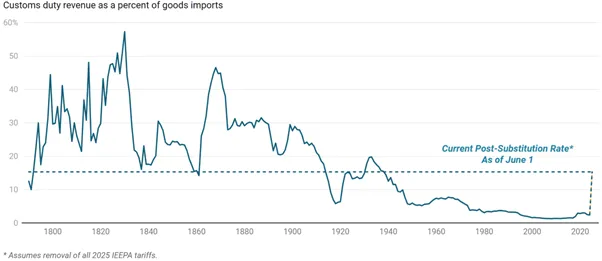
The dominant driver of market sentiment has been the rapid evolution of US trade policy. The White House’s decision to pause tariff increases for key allies helped restore confidence, even as elevated levies on Chinese imports persisted. This partial de-escalation calmed fears of a full-scale trade war, sending equities higher. However, legal challenges late in the month to the administration’s tariff authority, with a US International Trade Court ruling many reciprocal tariffs illegal - though temporarily stayed on appeal - exposed the fragility of the US tariff policy backdrop.

Average Effective US Tariff Rate

Chart showing US effective tariff rate since the 1800s

Source: The Budget Lab, budgetlab.yale.edu/research/state-us-tariffs-june-1-2025

In particular, the US-China relationship remains a critical point of uncertainty. While talks so far have produced modest agreements and helped ease immediate risks, the temporary nature of these deals leaves open potential for renewed volatility as deadlines loom and structural issues - industrial policy, technology transfer, and geopolitical rivalry - remain deeply entrenched. Meanwhile, the US further intertwined economics with geopolitics by deepening ties with Saudi Arabia through a record $142 billion arms deal and expanded cooperation in artificial intelligence sectors.

Despite the destabilising impact of tariffs, central banks have responded cautiously so far. The US Federal Reserve held rates steady this month, re-emphasising its data-dependent approach. Even though its preferred PCE inflation gauge moderated to 2.1%, the Fed maintains a hawkish bias in anticipation of tariff-driven price pressures. In contrast, the Bank of England cut rates by 25 basis points to 4.25%, citing cooling inflation and a weakening domestic economy. The European Central Bank maintained a dovish tone and is expected to ease further in June. These divergent paths reflect different economic realities either side of the Atlantic: the US faces stagflation risks, whilst reviving growth takes higher priority for Europe and the UK.

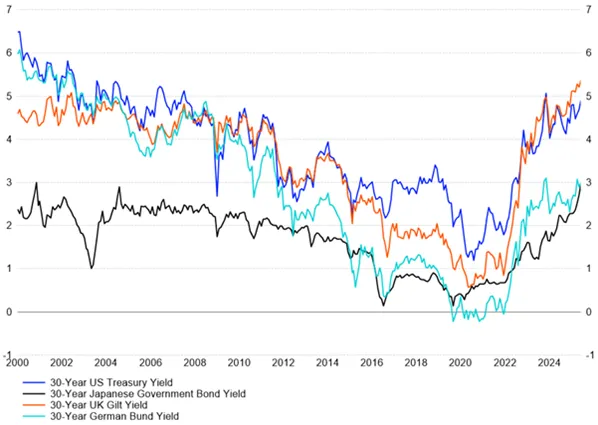
The US fiscal picture has also shifted meaningfully. The passage of President Trump’s “Big Beautiful Bill” - a sweeping package of tax cuts, new spending, and an increased national debt ceiling – has sparked concerns over long-term fiscal sustainability. Higher yields are demanded to compensate for the expected surge in Treasury issuance, pushing long-term US treasury yields to their highest levels in almost two decades. It is notable that this rise appears driven more by a growing recognition of fiscal risks and a rising term premium whilst, for now at least, less by inflation fears.

Long-term government bond yields

Picture3

Source: LSEG Workspace.

Against this backdrop, the equity market rebound in May was impressive. The S&P 500 surged over 6% - its strongest month since late 2023 - while the Nasdaq surged nearly 10%. It appears US retail investors have been keen to continue following a “buy on the dip” mentality, one that admittedly has proven successful in recent years. However, circumstances have changed, not least the US administration is no longer keen for US dollar revenues to be recycled back into its capital markets.

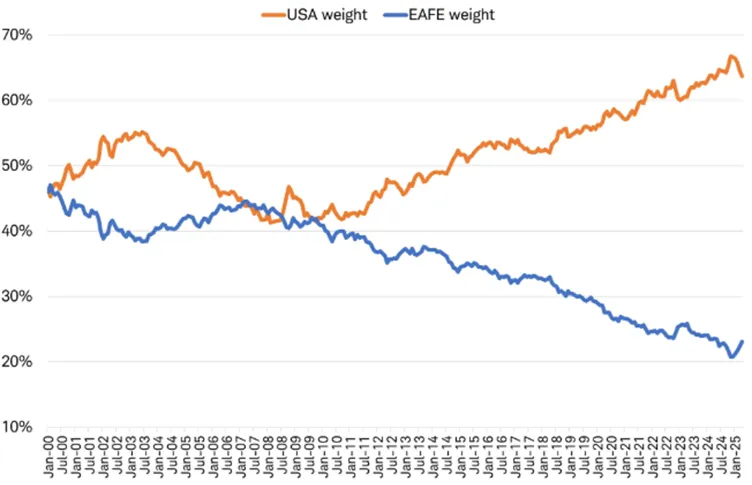
This has been made evident in section 899 of the “Big Beautiful Bill” that outlines the potential for the US to impose taxes on foreign holders of US securities. Coupled with trade policies that seek to punish those generating surplus US dollars, it is not a stretch to see a reallocation by global equity investors to their domestic and other (non-US) equity markets.

US equity weights have increased at the expense of other developed regions

chart showing US equity weightings increasing since July 09

Source: Charles Schwab, Hamilton Lane.

It is notable, however, that for sterling-based investors the US equity gains in May were muted by ongoing dollar weakness, leaving the US equity market’s returns in negative territory year-to-date in GBP terms. The dollar extended its decline, pressured by softening US growth data, policy uncertainty, and trade disruptions that saw first-quarter GDP contract. Meanwhile, European equities performed better than global peers, supported by the ECB’s dovish stance and a proposed €500 billion defence spending package that supports manufacturing and security sectors.

Your Money

This month we trimmed US exposure across the T. Bailey Funds of Funds portfolios through a partial sale of the iShares S&P500 Equal Weight UCITS ETF. As we continue to further diversify equity exposure we introduced a position in the newly launched Merlin Fidelis Emerging Markets Fund.

This fund differentiates itself by employing a disciplined, research-driven approach to emerging market stock-picking focussing on businesses with strong competitive advantages and with valuations that provide a strongly favourable risk-reward opportunity. The managers adopt a flexible approach without preset style, sector, or country biases, remaining receptive to opportunities wherever they may emerge. This research-driven methodology is further enhanced by a rigorous peer review system, ensuring that each investment thesis undergoes comprehensive evaluation before being added to the portfolio.

In the T. Bailey Multi-Asset funds, we also reduced our holding in Urban Logistics plc. The share price has exhibited strong performance since LondonMetric Property plc's initial bid for the company in April, with Urban Logistics achieving a year-to-date return of 56% by the end of the month.
Back to All Articles