T. Bailey Asset Management Limited do not provide advice to private individuals.

The information contained on this website is intended to provide information about our products and services and is not intended as investment advice. It is important that you do not rely upon its content to make investment decisions without seeking independent advice.

This website is intended for United Kingdom professional investors and advisers only. Please ensure you read the important legal information.

Navigating the AI Investment Landscape: Is the Momentum Trade Running Too Far?

Weekly Update
Global Equities Thematic Investing

The AI theme continues to dominate global equity markets, but soaring valuations and increasingly concentrated market leadership are raising important questions for investors. This week's update explains why T. Bailey has been reducing exposure to the AI theme while continuing to believe in its long-term potential.

This week we have seen the end of the 2nd quarter, and as investment managers, it is a time when we assess the winners and losers in our funds over that period. Perhaps unsurprisingly, the areas of the market that have been very strong over the quarter have been companies exposed to the AI narrative. For example, the US Semiconductors index was up 88% over the quarter, driven by earnings momentum that is forecast to grow by ~100% this year. The current weighting of US Semiconductor companies in the S&P 500 is ~19% versus 2% in 2015. This AI trade phenomenon is not unique to the US, as can be seen by the performance of both the Taiwan and South Korean markets returning 45% and 67% respectively over the quarter.

It is worth noting the inter-correlation of the “AI trade” across regions, as can be seen in the chart below from JP Morgan, and how concentrated certain markets are to it. This is an important observation that certainly passive investors should be aware of, as they may believe that they are diversified by region, but unaware that their greatest factor exposure risk is to the AI trade, given the concentration risk in some regional markets.
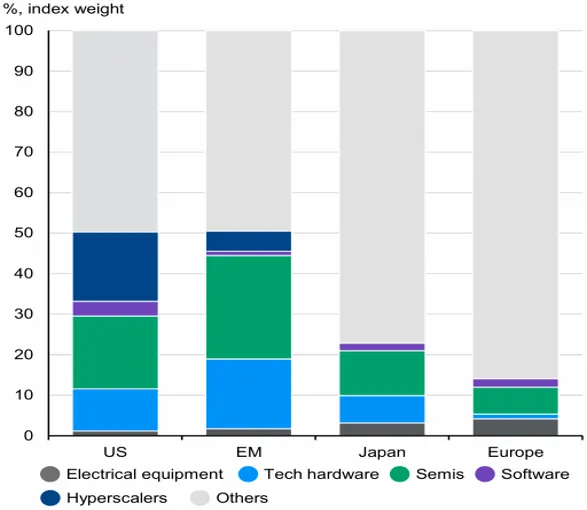

Equity Index exposure to AI-related industries

Picture2

Source: JP Morgan Asset Management July 1st 2026.

At T. Bailey, over the last few weeks, we have prudently been taking profit and reducing our exposure to the AI theme within our funds. We believe in AI, and how productive it is and will be to society; but in the near term we are concerned that this momentum trade may be getting ahead of itself; and so, it is prudent to manage the risk.

Data points that concern us include the recent daily stock and index moves that we have been seeing in both the Korean and Taiwanese equity markets, as volatility has really spiked in recent weeks. This has probably been exacerbated by retail money chasing momentum and lending to buy options on leveraged AI/tech related ETFs. In the US, we have also seen this momentum, as leveraged ETF funds focused on AI and technology companies more than doubled in assets in April and May, from $39bn to $84bn.

It was also interesting to note Meta’s announcement on the 1st of July. Meta announced that they are building a new cloud business to sell excess AI compute capacity, signalling that its current AI infrastructure is overbuilt relative to its own needs. Going forward, is Meta the first of other Hyperscalers with a similar overprovisioning of compute? Others may also follow, meaning there is a more elastic supply of AI compute available to enterprises, reducing the urgency to overpay for new chips.

Other questions we are trying to clarify and understand at T. Bailey, to help us navigate our investment in the AI theme, include: What happens if companies start limiting their token budgets meaningfully because they are not seeing an increase in ROI (Return on Investment), and as a result, compute demand either slows or we see a meaningful shift to the cheaper Chinese AI models, to reduce costs. Time will tell.

Back to All Articles