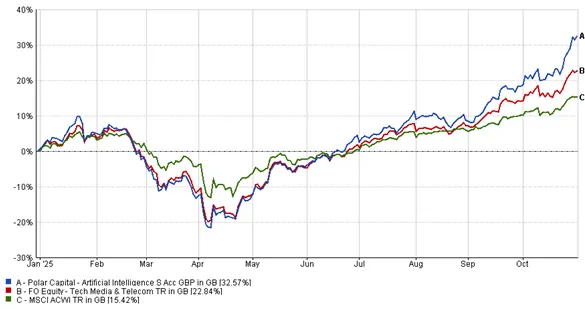
Political uncertainty drove volatility, but strong AI-related performance supported equities. Gold continued to benefit from risk aversion.
The month opened with a US government shutdown after Congress failed to reach agreement on a budget. Roughly 750,000 federal employees were furloughed and many public services temporarily halted. Meanwhile, the IMF warned of subdued global growth and persistent inflation pressures, reinforcing expectations that monetary policy would likely remain restrictive. Conditions were more constructive in Asia: the Reserve Bank of India held rates at 5.50% and raised its GDP forecast to 6.8%, while Japan’s quarterly Tankan survey showed improving confidence among manufacturers.
Healthcare was a notable sector. Mid-month, renewed White House commentary on drug-pricing reform - including references to “most favoured nation” rules and greater scope for government-negotiated discounts - put pressure on several large pharmaceutical companies, particularly those with significant exposure to US pricing dynamics. Areas of the market focused on biotechnology and medical technology innovation fared more resiliently as investors rotated away from companies most exposed to potential regulatory change.
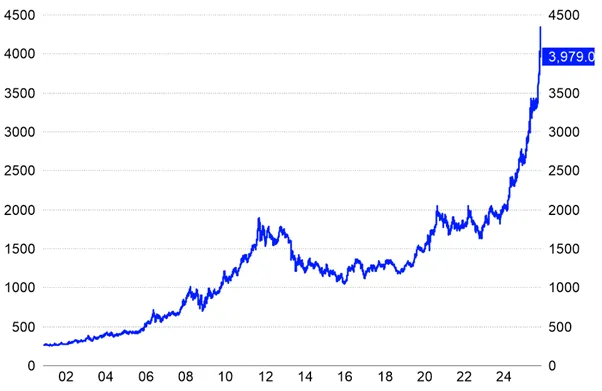
Gold illustrated safe-haven behaviour through much of the month. The metal surged above US$4,300 per ounce on 16 October, driven by geopolitical uncertainty, central-bank accumulation and demand for inflation hedging. In the T. Bailey Multi-Asset funds we took this strength as opportunity to take partial profits and reduce positions closer to long-term targets. The timing proved beneficial: during the week of 21 October, gold experienced one of its steepest single-day declines in years. However, in sterling terms, gold remains up more than 45% year-to-date. The Multi-Asset funds both currently hold gold positions of around 5%, providing diversification benefits without excessive concentration.