T. Bailey Asset Management Limited do not provide advice to private individuals.

The information contained on this website is intended to provide information about our products and services and is not intended as investment advice. It is important that you do not rely upon its content to make investment decisions without seeking independent advice.

This website is intended for United Kingdom professional investors and advisers only. Please ensure you read the important legal information.

Weekly Update – Record Highs, Narrow Foundations

Weekly Update
Portfolio Construction Global Equities Thematic Investing

US equity markets continue to reach record highs, but the gains have been far from evenly distributed. With a relatively small group of AI-linked companies driving much of the advance, we examine what market concentration means for investors and how thematic investing can help identify opportunities beyond the most prominent names.

Record highs in US equity markets suggest a healthy backdrop for investors but beneath the surface the picture is less convincing. A relatively small group of large, AI-linked companies has been driving returns, while many other businesses have struggled to keep pace. This raises questions about the foundations of the ongoing rally and where to look for opportunities beyond it.

The contrast is apparent in the performance of the S&P 500 index and its equal-weighted counterpart. Both contain the same companies, but giving each company a similar weight has produced considerably lower returns in recent years.
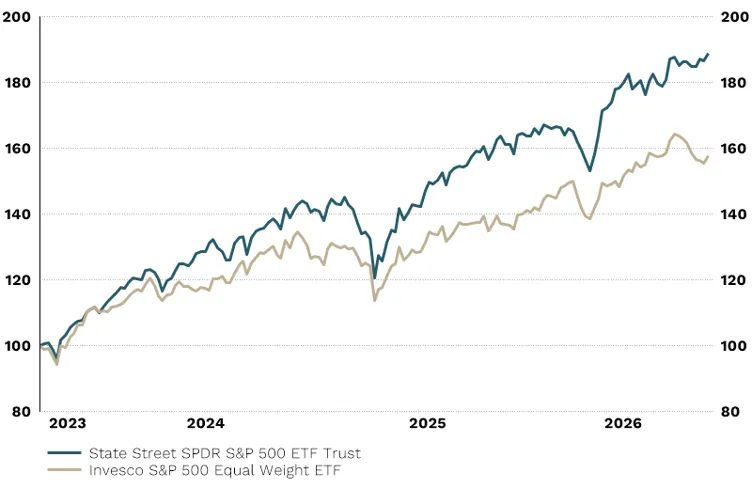
Same companies, different weights

ETF proxies for the S&P 500 and its equal-weighted counterpart

Picture1

Source: LSEG Workspace. Total return, USD terms. Rebased to 100 at 30 September 2023.

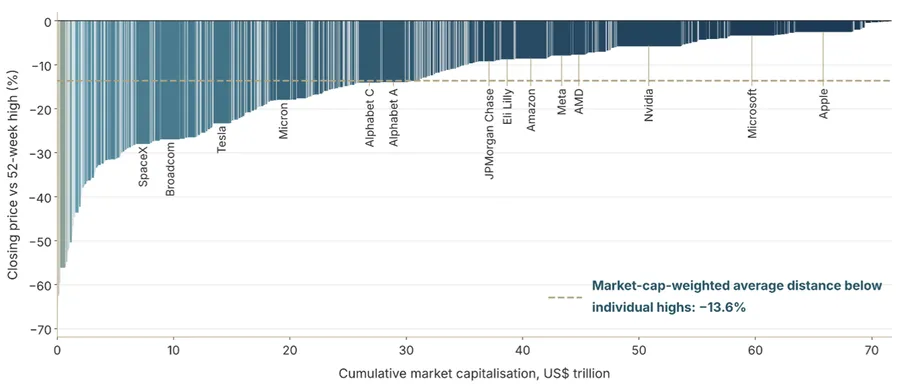
Considering individual shares provides another perspective. Among the roughly 500 largest US-listed shares, the typical share is about 15% below its own 52-week high, and a quarter are more than 26% below. Yet just over half of total market value sits within 10% of its high.

Nvidia, Apple and Microsoft together make up about a fifth of the total and are all within 6% of their highs. Even within technology, performance has been uneven, with some prominent businesses much closer to their peaks than others. Strength in the headline index does not necessarily mean strength across the wider market.

Distance from 52-week high

Largest US-listed shares by market capitalisation, ranked by distance below their 52-week high. Bar width reflects market capitalisation.

Picture2

Source: T. Bailey, LSEG Workspace.

Narrow leadership is not, in itself, a reason to expect markets to fall. It does, however, make them more dependent on the companies leading the advance. Questions about AI revenues and the substantial financing needed to build the supporting infrastructure have significance beyond the technology sector. Investors across the wider market have an interest in whether that spending ultimately generates attractive returns.

For us, the response is not to dismiss AI or assume that companies left behind must necessarily catch up. Some businesses have strong reasons for attracting investors’ capital. Others face challenges that a lower share price will do little to resolve.

Considering investment themes provides a starting point for us to address this. They help us identify areas where structural changes could support demand and improve a company's long-term prospects. But a favourable backdrop does not make every business exposed to it an attractive investment. Competitive advantages, financial strength and the price paid still matter.

As a thematic fund of funds investor, we draw on carefully selected active managers to do that detailed work. Their specialist research, sector knowledge and access to companies provide the resources to investigate opportunities beyond the most prominent names. Our role is to assess those managers and how their funds fit together, looking through the holdings to understand where exposures overlap.

Owning several funds does not necessarily provide several different sources of growth. If their holdings depend on the same customers, spending plans or market expectations, portfolios containing them may be less diversified than appears. We want themes to broaden our search for opportunities, not simply give us different ways of owning the companies already driving the index.

Download article as PDF
Back to All Articles