September's flash PMI surveys point to stronger-than-expected growth in the US and eurozone, but also renewed inflation pressures that could keep interest rates and bond yields higher for longer. The UK faces a more difficult combination of slower growth and rising costs, reinforcing the case for selectivity.
Last week’s flash PMI surveys showed the US and eurozone economies growing faster than expected. But they also showed rising cost pressures that point to interest rates and bond yields staying higher for longer.
S&P Global’s flash purchasing managers’ indices, released last Wednesday, provided an early indication of economic activity in September. For the US, the composite PMI rose from 56.0 to 58.4, its strongest reading since July 2021. S&P Global estimates that the surveys are consistent with annualised GDP growth of around 4% in the third quarter, while employment growth was the strongest for more than four years.
The eurozone also pleasantly surprised with its composite PMI increasing from 52.0 to 53.1, the highest level since April 2023, whereas many economists had expected a modest decline. In this case, the survey is estimated to be consistent with quarterly GDP growth of around 0.4%.
Unfortunately, however, the UK was the exception. Its composite PMI slipped from 52.5 to 51.7 as services activity slowed, pointing to quarterly growth of around just 0.1%, compared with 0.4% in the second quarter.
Nonetheless, with readings above 50 indicating economic expansion, activity is supportive of corporate earnings and helps explain why equity markets have remained resilient, even as rising yields have made investors more selective.
However, the surveys carried a less comfortable message on inflation. US input costs were reported to have risen at their fastest rate for almost four years, driven by higher fuel and transport costs. Furthermore, backlogs of work have also been growing, suggesting that capacity pressures are beginning to build as demand improves. Alongside faster input-cost inflation, this raises the risk that businesses will seek to pass higher costs through to customers.
Central banks are already tightening policy. The Federal Reserve raised rates on 16 September for the first time since 2023, following the European Central Bank the previous week. These latest surveys make it harder for policymakers to assume that inflation pressures will fade quickly and make further rate rises more likely.
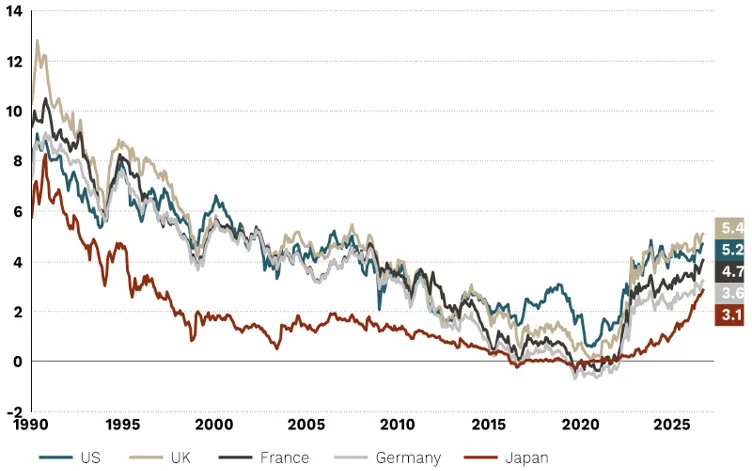
The bond market reflects that inflation concern. The US 10-year Treasury yield has risen to 5.2%, its highest level since July 2007, as investors weighed stronger activity data, a weak five-year Treasury auction and hawkish comments from the Federal Reserve.