
Key Market Insights
- Bond markets questioned fiscal credibility, with higher UK gilt yields, a weaker Sterling, and France’s downgrade for rejecting spending cuts.
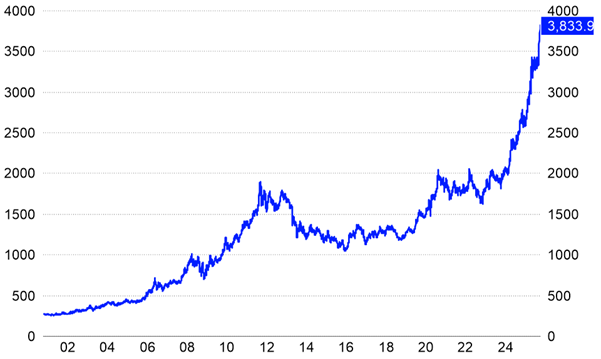
- Gold rose above US$3,800 amid safe-haven demand as the Fed cut rates while the ECB and BoE held steady.
- Portfolio gains came from gold, Asian equities, and Chrysalis’s Klarna IPO; AI exposure was trimmed amid market exuberance.
September began with bond markets questioning the longer-term fiscal credibility of developed western economics.
In the UK, the treasury sold a record £14 billion of gilts at higher yields last seen 27 years ago, and Sterling fell sharply. US Treasuries also came under pressure as the Trump administration escalated its confrontations with independent institutions like the US Federal Reserve. France removed its Prime Minister, François Bayrou, rejecting €44 billion of planned cuts despite debt already representing 114% of GDP. Fitch downgraded France’s debt, citing fiscal and political instability.
Long-dated Government Bond Yields

Source: LSEG Workspace.
In contrast, gold surged past US$3,500 per ounce and climbed above $3,800, supported by safe-haven demand, loose fiscal backdrops and deteriorating trust in government finances.
Gold Bullion Price (London Bullion Market, USD/troy oz)
Source: LSEG Workspace.
At the shorter end of the government bond yield curve, the US Federal Reserve delivered its first rate cut of 2025, lowering the target range by 25 basis points to 4.00–4.25%. Fed Chair, Jerome Powell, described the move as risk management, citing weaker labour demand and moderating household spending. Stephen Miran, attending his first policy meeting as a new governor favoured by the Trump administration, dissented for a 0.5% cut and projected faster easing into year-end. Justification was evident in the labour market as August payrolls rose just 22,000 against 75,000 expected, June was revised to show a loss of 13,000, and longer-term revisions removed 911,000 jobs from the March 2024–March 2025 period. However, US inflation pressures remain persistent, pulling the US Fed in opposite directions.
The European Central Bank and Bank of England opted to hold rates steady. The ECB kept its deposit rate at 2% as eurozone inflation edged up to 2.1%. The Bank of England left its rate at 4% albeit slowed its pace of quantitative tightening.
The US closed September with a government shutdown, furloughing 750,000 federal employees after Congress failed to pass a budget. President Trump announced 100% tariffs on imported branded pharmaceuticals from 1 October, alongside duties on selected furniture and trucks, while also pressing TikTok’s forced sale.
Equity markets continued to be dominated by the artificial intelligence theme. Nvidia pledged up to US$100 billion to finance OpenAI’s future hardware orders. While this secures revenue to Nvidia in the short term, it ties Nvidia’s growth to a partner that’s not expected to be cash-flow positive before 2029. History offers clear warnings in this regard where telecom suppliers in the late 1990s and General Electric in the 2000s used similar vendor-financing models that ultimately collapsed when customers defaulted.

Source: Prof G Markets, 29 September 2025.
In contrast to US and global equity indices, exposure to Nvidia has been deliberately kept low across the T. Bailey fund of funds portfolios, and exposure to the AI theme was trimmed further this month through the Polar Capital Artificial Intelligence Fund. Although its manager notes a shift from hyperscalers to broader AI beneficiaries we believe prudence remains warranted in this corner of the market as signs of misallocation and exuberance begin to show.
Overall, performance for the month was supported by gold holdings, Asia ex-Japan allocations and thematic technology strategies. Chinese sentiment improved after Beijing introduced measures to shore up consumption and stabilise financial markets. Taiwan’s semiconductor sector and other Asian technology names benefited from the same themes driving AI enthusiasm.
A highlight came from Chrysalis Investments, held across each of the T. Bailey fund of funds. Klarna’s New York IPO was the largest of 2025, priced at $40 per share and more than 20 times oversubscribed, valuing the business at $15.2 billion. The deal improved Chrysalis’s liquidity profile, with around 30% of NAV now in cash or listed securities.
As the final quarter of 2025 begins, markets face diverging central bank paths, unresolved fiscal risks, and historic equity concentration. Facing this, the T. Bailey approach remains consistent: maintain diversification, liquidity and risk discipline, trim exposures where exuberance outweighs fundamentals, and focus on long-term resilience.