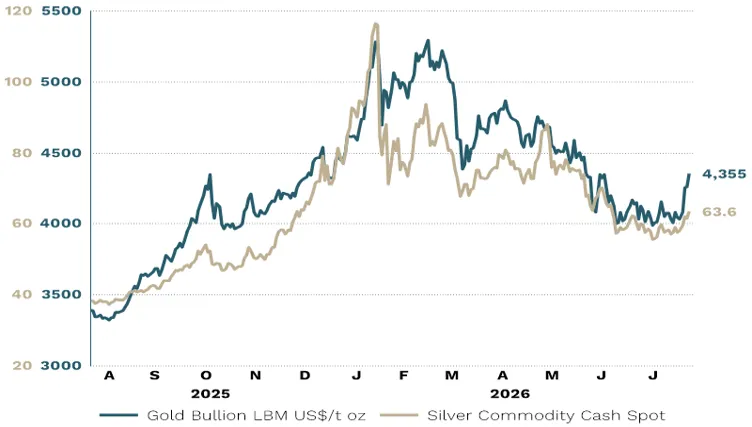
ADP's July report, admittedly a volatile index, showed private employers added just 44,000 jobs, well short of the roughly 70,000 economists expected and down from a downwardly revised 95,000 print in June. The same day, the ISM services employment report slipped back into contraction. Against the backdrop of the weak labour market data, market-implied odds of the Fed holding rates steady in September rose to over 50%, their highest level in over a month.
Nonetheless, the Fed has given little forward guidance beyond a hawkish emphasis on inflation still running above target. Fed Chair Kevin Warsh has been deliberately sparing with forward guidance since taking office on the basis that excessive communication simply encourages markets to trade rhetoric rather than underlying data. This week may be an example of that approach working with gold and silver reacting to a jobs miss and easing concerns over oil-supply disruption, rather than officials’ comments on further tightening. Alternatively, markets may be concluding that the central bank has yet to catch up with its own data.
As we set out earlier in the year (Weekly Update, 2 February 2026), our investment case for gold rests on more than the near-term policy outlook: central-bank demand, fiscal uncertainty and the role of real assets in portfolios remain important supports. Central banks have remained buyers, purchasing 289 tonnes in the second quarter, up 62% on a year earlier and the strongest second quarter on record according to The World Gold Council. Its latest survey of reserve managers found that a record 45% plan to increase their own gold holdings over the next year, and 89% expect global reserves to keep rising.
The point is not that the Fed has lost credibility, it is that gold is currently being driven by buyers largely indifferent to Fed rhetoric. This argues for continued exposure to real assets through whatever the Fed may, or may not, say next.