T. Bailey Asset Management Limited do not provide advice to private individuals.

The information contained on this website is intended to provide information about our products and services and is not intended as investment advice. It is important that you do not rely upon its content to make investment decisions without seeking independent advice.

This website is intended for United Kingdom professional investors and advisers only. Please ensure you read the important legal information.

8 June 2026: Weekly Update – The Capex Cycle's Moment of Truth

Weekly Update
Market Commentary Global Equities Thematic Investing

Broadcom's earnings disappointment and rising Treasury yields triggered a sharp market reversal during the week, prompting renewed questions about the sustainability of the AI investment cycle. The update examines whether current valuations are being supported by genuine end-user demand or by a self-reinforcing capital expenditure boom that may be approaching its limits.

This week began at all-time highs and ended with the worst single day for US equities since October. Broadcom's record earnings were punished for being merely extraordinary. But the more important question is not whether the numbers were good enough - it is what they are actually made of.

On Wednesday evening, Broadcom reported exceptional results yet the stock fell over 12% on Thursday and a further 8% on Friday, because its forward guidance, particularly around AI revenues, had missed analyst expectations. That is the market this AI cycle has become: one in which a small miss on a record quarter is treated as a failure. South Korea's Kospi index - up over 100% in 2026 to the end of May as the world's most concentrated pure play on the AI buildout - fell as much as 7% during Friday’s session. A jobs report showing US hiring at more than double the expected rate compounded the move, pushing Treasury yields sharply higher and extinguishing what remained of any rate-cut narrative.

The earnings growth underpinning AI equity valuations has been generated by the capital expenditure cycle itself rather than by proven end-user demand. The hyperscalers and their suppliers have been spending - on chips, data centres, energy infrastructure - at a rate that has produced strong revenues and earnings throughout the supply chain. The capex cycle has been validating itself through the earnings of the very companies it is paying. Whilst this is not a fraudulent arrangement, it is a circular one, that will eventually assert itself.
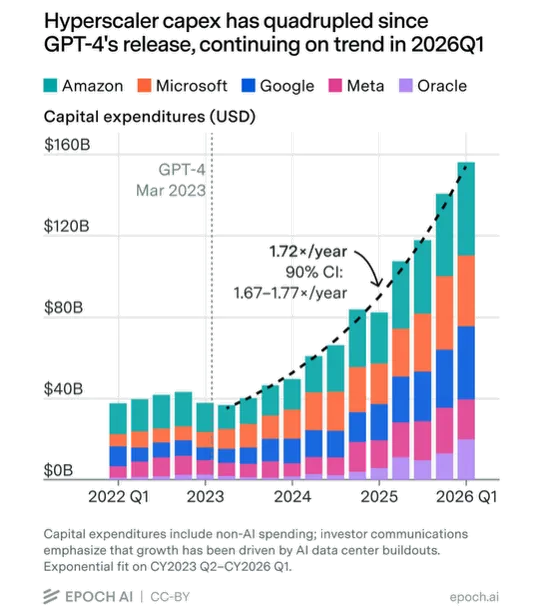

Hyperscaler Capex

Picture1

Source: Epoch AI, 28 May 2026.

For the cycle to become self-sustaining, the capital deployed must generate returns in the form of AI-driven revenues at scale: tokens consumed, inference demand met, productivity gains monetised. Those output-side revenues have not yet grown to a scale commensurate with the capital already committed. Until they do, the earnings trajectory that justifies current multiples requires the capex cycle to keep expanding. What the Broadcom guidance hesitation likely communicated to the market is that the expansion is approaching a limit, before the output revenues have grown large enough to take over as the primary engine. We continue to retain exposure to the AI theme through specialist managers, and nothing here challenges the long-run case for the technology. The question, as always, is whether the price of these companies holds up relative to what they must now prove.

Answering that question became harder this week. Two centrist US Federal Reserve policymakers made openly hawkish statements. One suggested that policy is not meaningfully restraining the economy. This is closely related to the argument above: when the perceived strategic cost of falling behind in artificial intelligence exceeds the financial cost of capital, rate rises that would discipline an ordinary investment cycle are simply absorbed. The Fed has been pushing against a tide of committed capital expenditure that has its own momentum. Into this, Kevin Warsh will chair his first FOMC meeting on 16-17 June - inheriting a divided committee, a labour market running well above trend, and an energy backdrop that is hardening from a temporary shock into something more lasting.

Beneath all of this, the more mundane healthcare, insurance, water and waste, and value equity holdings within the T. Bailey funds of funds moved through the week largely on their own terms. Their earnings are not contingent on a capital cycle validating itself through future token consumption. Drug revenues, treated water volumes, insurance premiums and tipping fees are the proceeds of things already sold - not promises about what artificial intelligence might eventually generate. The valuation gap between healthcare and technology equities, which we discussed here, narrowed fractionally this week but remains historically extreme.

The businesses that require only that they continue doing what they have always done tend not to feel rewarding in weeks when everything is going up. They tend to feel rather more important in portfolios during weeks like this one.

Back to All Articles