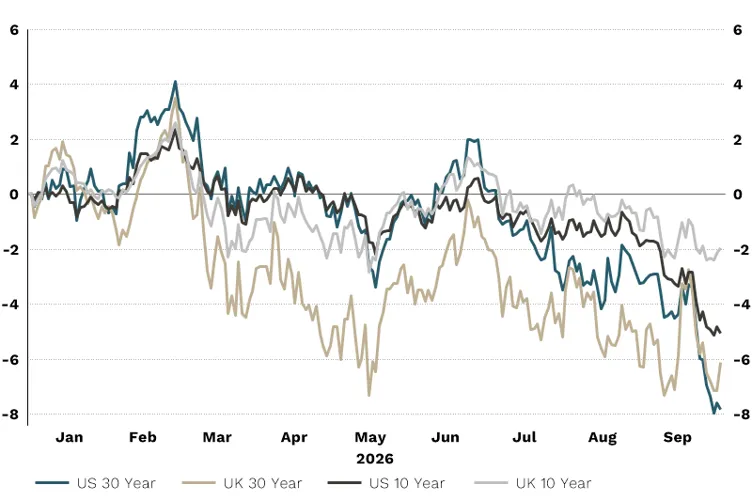
For the US, the story behind these moves is, to a large degree, one of economic resilience as we reported last week. Large technology companies are raising debt to fund AI infrastructure, including data centres, chips and power capacity, a key leg of the US growth story. But this also means both governments and companies are competing for the same pool of long-term capital. Softer recent jobs data reduces the immediate case for a further US Federal Reserve rate increase, but the broader economy continues to prove stronger than expected. That makes a rapid return to the low policy rates of the post-financial-crisis period unlikely.
There is also the more structural factor of US federal debt. This has passed US$40 trillion and the annual fiscal deficit is expected to approach US$2 trillion. The Treasury must refinance maturing debt and issue substantial quantities of new bonds to finance continued borrowing demands.
The overall result has been a higher term premium - the extra return investors require to hold long-dated bonds amid uncertainty over inflation, future interest rates and the supply of debt. This helps explain why long-term yields may remain elevated even if central banks eventually begin to reduce short-term policy rates.
The UK shares similar pressures to those of the US, but has its own, additional factors of concern. In particular, as a net energy importer, the UK is more exposed to a sustained increase in oil and gas prices. Despite recent improvements to shipments in the Strait of Hormuz, Brent crude has continued to trade close to US$100 a barrel. Damage to refining infrastructure from Ukrainian attacks on Russian refineries, alongside disruption from the US-Iran war, have constrained supplies of refined products which will likely maintain pressure on fuel markets. Prolonged high energy prices risk feeding into household costs, business margins and inflation expectations.
Fiscal credibility also matters. With borrowing above official forecasts and the Autumn Budget approaching, UK gilt investors will be alert to evidence that the government can set out a credible path for debt and borrowing.
For longer-term investors, higher yields have restored meaningful income to government bonds and improved the prospective returns available, offering a very different starting point from the ultra-low-yield environment from the years since the financial crisis. However, higher income alone does not guarantee positive capital returns. Should growth slow decisively, energy prices ease and inflation fall, today’s yields could prove attractive and long bonds may generate capital gains. But if inflation remains sticky, government borrowing stays high and investors demand an ever larger term premium, yields could continue to rise further, especially at the long end.
For the T. Bailey Multi-Asset Growth Fund and T. Bailey Multi-Asset Dynamic Fund portfolios, this argues for selectivity rather than a broad return to duration. Short-dated bonds offer attractive income with limited sensitivity to further rises in long-term yields. Intermediate maturities provide a more balanced combination of income and potential protection if growth deteriorates. Long-dated bonds are becoming more interesting, but they have greater exposure to inflation, fiscal and supply risks.
Higher yields have increased the appeal of bonds, but they have not made all durations equally attractive. We continue to favour a diversified approach, with a focus on income, careful duration management and assets supported by strong cash generation rather than an assumption that long-term interest rates will quickly return to their previous lows.