T. Bailey Asset Management Limited do not provide advice to private individuals.

The information contained on this website is intended to provide information about our products and services and is not intended as investment advice. It is important that you do not rely upon its content to make investment decisions without seeking independent advice.

This website is intended for United Kingdom professional investors and advisers only. Please ensure you read the important legal information.

Weekly Update – Rotation, not retreat

Weekly Update
Portfolio Construction Market Commentary Thematic Investing

This week’s update examines the uneven market reaction to the US mid-term elections, including pressure on technology and AI-related investments, and considers why selectivity and diversification remain important across the T. Bailey funds of funds.

Last week’s mid-term elections prompted some sharp market moves. However, selling was uneven, with the largest losses in technology and energy sectors as investors assessed the implications of the results. Elsewhere, the picture was more resilient. Several of our underlying holdings with alternative sources of return made gains, highlighting the value of looking beyond the AI investment cycle.

The Democrats won both the House and the Senate in the US mid-term elections. Over the week, US equities fell 2.3%, Japanese equities lost 6.5% and South Korean equities declined 13.9%. UK equities (-0.4%) and European equities excluding the UK (+0.7%) held up far better. (All returns are total returns in sterling terms.) Energy shares weakened as oil prices fell on hopes of an end to the Iran war.
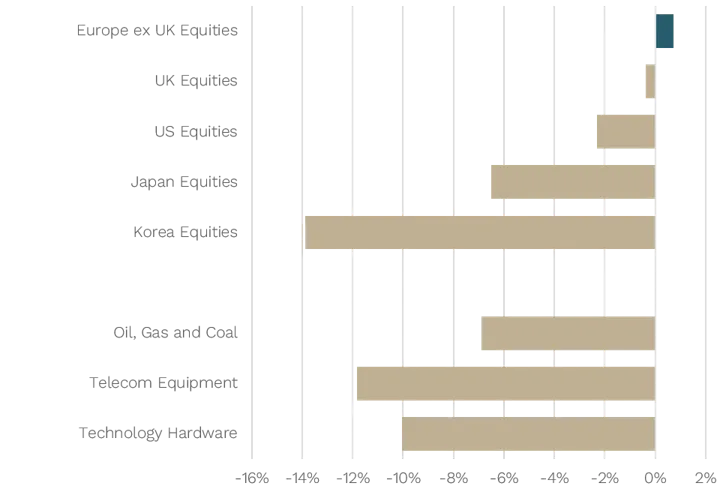
Underlying holdings: strongest and weakest returns, week to 6 November 2026

Picture1

Source: T. Bailey, LSEG Workspace. Total return, GBP terms. Best and worst performing holdings across all T. Bailey fund of funds portfolios for the week ended 6 November 2026.

For AI infrastructure spending, state and local results of the mid-term elections may matter more than the national outcome. Voters showed widespread opposition to data-centre development, while incoming Democratic governors in Texas, Ohio and Georgia campaigned for pauses or tighter conditions - concerns they will need to balance against investment and jobs in their states. This need not bring construction to a halt, but it will likely make approvals slower and more costly, ultimately favouring those developers with stronger balance sheets. Slower construction could also delay orders and revenues for suppliers of chips, equipment and construction services, making earnings expectations harder to meet and adding a permitting risk to the financing concerns we covered last week.

Nonetheless, the broader economic picture was firmer than the market falls might suggest. US unemployment fell in October, complicating the case for lower interest rates. A divided US government may limit the scope for major new tax and spending measures, but the US Federal Reserve’s approach to monetary policy will continue to depend on the economic data. Furthermore, Democratic control of the Senate will provide a check on future Fed appointments, potentially reducing concerns about political interference.

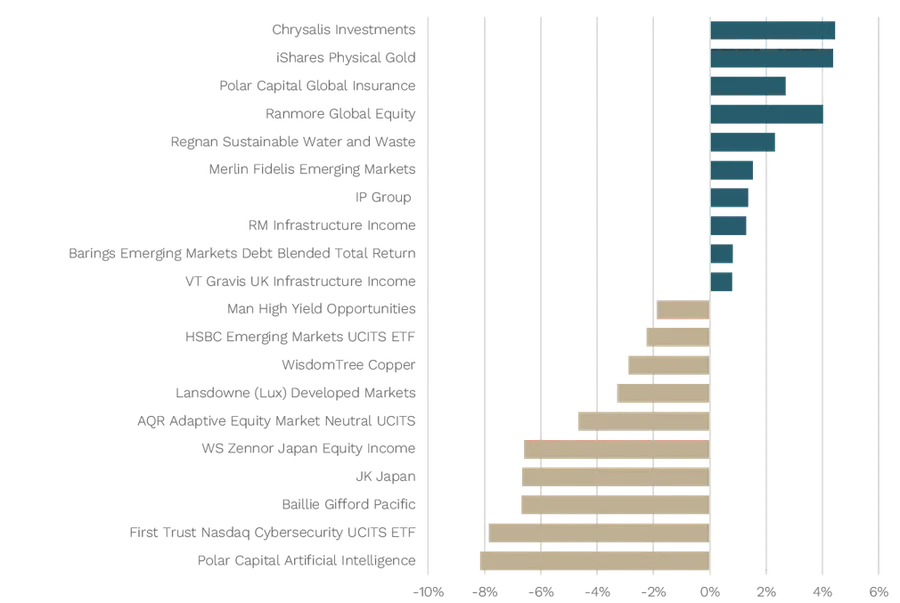
The following table shows the strongest and weakest returns among the underlying holdings across the T. Bailey funds of funds over the week:

Underlying holdings: strongest and weakest returns, week to 6 November 2026

Picture9

Source: T. Bailey, LSEG Workspace. Total return, GBP terms. Best and worst performing holdings across all T. Bailey fund of funds portfolios for the week ended 6 November 2026.

AI and cybersecurity funds were among the hardest hit holdings, alongside Asian equity strategies. Our exposure to the latter includes chip and memory suppliers whose prospects are tied to US technology spending. The strongest holdings included gold (held in the multi-asset funds) alongside insurance, utilities and value strategies, illustrating a range of opportunities beyond the AI theme.

That said, we continue to consider AI an important driver of long-term economic growth. But that does not make every part of the investment chain equally attractive. Demand can keep growing while projects take longer, costs rise and suppliers fall short of investors’ expectations. In our Global Thematic Equity Fund, we remain selective about how we access that growth. In our Multi-Asset Growth and Multi-Asset Dynamic funds, we also consider how much AI-related risk to take alongside opportunities in other asset classes. Across all three T. Bailey funds of funds, we remain willing to invest in AI’s long-term potential, but not on the assumption that every ambitious spending plan will translate into profitable growth.

Download article as PDF
Back to All Articles