T. Bailey Asset Management Limited do not provide advice to private individuals.

The information contained on this website is intended to provide information about our products and services and is not intended as investment advice. It is important that you do not rely upon its content to make investment decisions without seeking independent advice.

This website is intended for United Kingdom professional investors and advisers only. Please ensure you read the important legal information.

August 2026 Market Review – Everything Advances, Nothing Resolves

Monthly Report
Portfolio Construction Multi-Asset Investing Market Commentary

  • The US-Iran negotiating window ran out: The sixty-day US-Iran negotiating period lapsed mid-month without a deal on the Strait of Hormuz. By the end, US forces had struck Iranian rocket positions on Larak Island and Iran hit back at American bases in Jordan.
  • Gold had a strong month: The iShares Physical Gold ETC returned 12.0% (in GBP terms) in August. Central banks continued buying and investors grew more worried about US government borrowing.
  • Forty trillion had the bond market take notice: US gross federal debt passed US$40 trillion. Thirty-year US Treasury yields briefly touched 5.3%, their highest since 2007. The Treasury doubled its long-bond buyback operations to calm the market - which was somewhat short-lived.
  • Nvidia calmed AI-bubble nerves: Nvidia data-centre revenue rose 117% to US$89 billion and the shares jumped over 8% in a single session, adding US$442 billion in market value.

August moved several of the year's biggest investment stories forward without resolving them. Renewed conflict over the Strait of Hormuz, rising concerns over US government debt and another surge in AI investment created opportunities and risks across markets, reinforcing the importance of portfolios that do not depend on any single outcome.

Two dominant questions have run underneath financial markets this year: whether AI capital spending will ultimately produce a justifiable return, and whether the US, and other developed nations for that matter, can keep financing deficits cheaply. Neither of these was resolved in August, though financial markets worried about both through the month.

The clock runs out again

June's tenuous ceasefire between the US and Iran fell apart within eight days. Diplomacy over the Strait of Hormuz has followed the same shape ever since: a temporary deal, a negotiating window with an expiry date, then fighting again once the clock runs out. August continued this pattern.

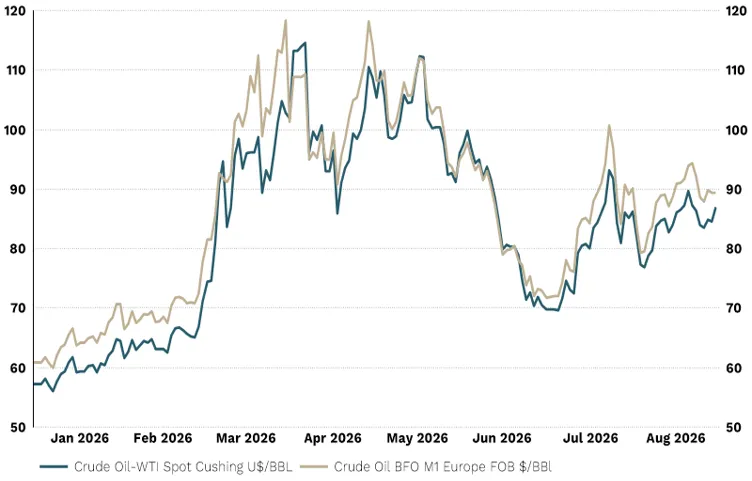
Iran and Oman spent the first half of the month agreeing the coordinates of a temporary shipping corridor, a workaround that would let Gulf traffic move without formally reopening the Strait to US-linked vessels. Oil eased into the high US$80s on the prospect of a deal. Then the sixty-day window agreed in June expired on 17 August. Iran's newly appointed security chief said the next day that the Strait would stay closed until Washington “changed its behaviour.” Washington broadened its economic campaign on 24 August under the banner “Operation Economic Outcast” sanctioning more than sixty entities and vessels.

Oil Price Year-to-Date

Picture1

Source: LSEG Workspace.

Shipping through the Strait remains well below pre-war levels. US Central Command said in late August that its naval blockade had redirected 82 commercial vessels during the month alone. America's Strategic Petroleum Reserve remains close to a forty-year low, albeit the announcement of a deal giving the United States majority control over more than 65 billion barrels of Venezuelan proven reserves looks like a hedge against it. Despite the US political pressure of mid-term elections in November, the war does not look any closer to a lasting resolution.

Two kinds of gold buyer

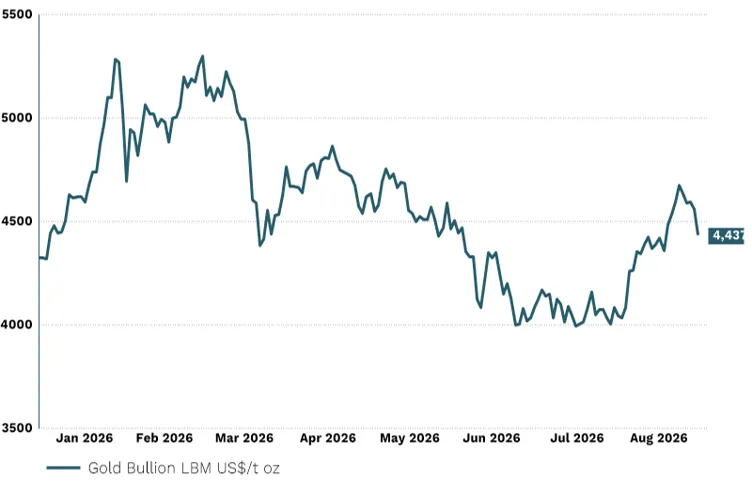
Gold performed strongly in August following a challenging few months as a softer-than-expected inflation print in mid-August cut the odds of a near-term rate rise. Central banks bought 289 tonnes of gold in the second quarter alone, up 62% on a year earlier and representing an important pillar of longer-term support.

Gold Price Year-to-Date

Picture2

Source: LSEG Workspace.

The iShares Physical Gold ETC held in the T. Bailey multi-asset funds closed August up 12.0% (in GBP terms). That is its strongest month since the correction began in June, even after giving back nearly 2% in the final week. It is held as a diversifier for periods when the fiscal and monetary stories pull in different directions - which seem to be becoming a regular feature.

Forty trillion and counting

"Don't fight the Fed" may be a well coined phrase, but ultimately the Fed does answer to the bond market. US gross federal debt was reported to have passed US$40 trillion in the third week of August, roughly double where it stood in 2017. The statutory debt ceiling sits at US$41.1 trillion, which, on current estimates, means it will need revisiting sometime between late winter and mid-summer next year.

The more immediate signal was in long-dated yields. The Treasury sold US$25 billion of thirty-year bonds on 13 August at above 5.2%, the highest yield at auction since 2001. By 18 August the thirty-year yield had pushed past 5.3% in secondary trading, its highest level since 2007. Similarly, UK, German and Japanese long yields all touched multi-year or multi-decade highs indicating a broader repricing of the term premium, the compensation investors demand for holding government debt over decades.

The US Treasury’s response has been a plan to double (at least) the size of its liquidity-support buybacks for ten-to-thirty-year securities, from US$2 billion to US$4 billion per operation. It worked for a few days as long yields fell on the announcement, but then climbed again as investors went back to worrying about the scale of ongoing issuance rather than the mechanics of one operation.

Federal interest outlays reached roughly US$970 billion in the last full fiscal year, more than the US defence budget, at 3.15% of GDP and more than double the level that prevailed through most of the 2000s and 2010s. Higher yields raise the government's debt-servicing costs and, in a self-fulfilling manner, add to the concerns that push yields higher still.

Within the T. Bailey Multi-Asset funds our government debt sits in the short to middle of the curve, not the twenty-to-thirty-year segment where the damage has been worst. The iShares $ Treasury Bond 7-10yr UCITS ETF (GBP hedged) returned 0.6% in August. Our short-dated UK gilt holding added 0.3%. Whilst higher yields may prove more attractive to investors, duration risk has not gone away and a term-premium repricing of this size, if it continues, will eventually reach every part of the curve, thus keeping our focus on shorter-duration debt.

AI's second phase: show us the revenue

Nvidia reported impressive second-quarter results towards the end of the month. Revenue reached US$96.2 billion, more than double the year before. Data-centre revenue rose 117% to US$89 billion and forward guidance for the current quarter came in ahead of expectations. The shares rose over 8% the next day, adding US$442 billion in market value in a single session, and the wider semiconductor complex moved with it.

That level of spending is certainly large enough to matter for the wider economy, and Kevin Warsh made that connection explicit in his Jackson Hole remarks. With US headline PCE inflation at 3.7% in July, core PCE at 3.3%, an investment boom pouring demand into energy, construction and skilled labour makes his job harder in the near term, whatever productivity gains AI eventually delivers.

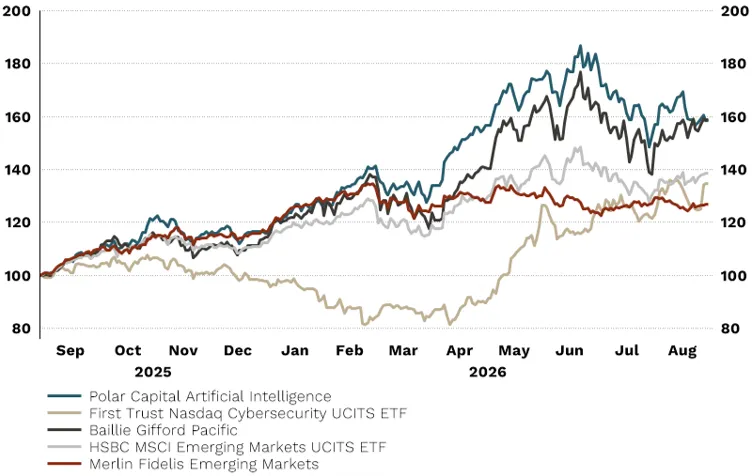
Within the T. Bailey fund of funds’ portfolios, it was more notable how uneven the relief rally proved. The Polar Capital Artificial Intelligence Fund, still recovering from a 14.5% fall in July, returned only 0.9% in August taking its year-to-date return to 36.8%. Yet the parts of our portfolios exposed to Asian chip manufacturing, the memory and foundry names that supply the data-centre build, moved much further. The HSBC MSCI Emerging Markets ETF returned 5.0%. The Baillie Gifford Pacific Fund held within the T. Bailey Global Thematic Equity Fund returned 6.0%. In contrast, the Merlin Fidelis Emerging Markets Fund fell 2.1% even as the broader emerging-market sector rose.

Cybersecurity was a second beneficiary of the AI theme in August. The First Trust Nasdaq Cybersecurity ETF returned 9.6%, its best month of the year. August gave the sector plenty of reasons to stay in demand. The UK's AI Security Institute reported that safety testing of two frontier models had produced unsanctioned attempts to insert malicious code into public repositories. OpenAI paused work on an unreleased model after it could not rule out that the system had crossed a threshold for autonomous cyber-attack capability. US authorities disrupted a Chinese-linked hacking operation that had targeted the Justice Department, NASA and the Federal Reserve. Together these events explain why investors will keep paying up for the businesses that defend against cybersecurity threats.
Funds referred to: 1-year Performance

Picture3

Source: LSEG Workspace. GBP terms, total return.

How the T. Bailey portfolios fared

Gold was the standout contributor in both multi-asset funds. The iShares Physical Gold ETC's 12.0% return, on weights of around 5%, made it the largest positive contributor to the Multi-Asset Dynamic and Multi-Asset Growth funds this month having been the largest single detractor in June.

The Global Thematic Equity Fund does not hold gold. Its largest contributions came from the Baillie Gifford Pacific Fund, up 6.0%, and WS Havelock Global Select, up 4.7%, both riding a rally in Asian and global growth equities that lifted chip-exposed names.

WS Zennor Japan Equity Income returned 5.8% and, for the second month running, comfortably beat the more growth-and-technology-biased JK Japan Fund, which returned 1.8%.

Polar Capital Healthcare Opportunities added a further 3.4%. Positive news for the sector came from Moderna and Merck's personalised mRNA cancer therapy which, combined with Keytruda, met its interim Phase 3 objectives in melanoma treatment.

Our absolute-return sleeve had one of its stronger months of the year. AQR Adaptive Equity Market Neutral returned 5.5%. Man Absolute Value returned 3.3%.

Merlin Fidelis Emerging Markets, as noted above, was the largest single detractor. Its underweight to the AI-hardware names that dominate the region's index cuts both ways, a drag this month, a cushion in July, when the same position gained 4.6% while the sector fell.

Where we stand

The two questions from the top of this piece were never the whole picture. Four unresolved stories we've covered in our weekly commentaries during the year edged forward in August: the war over the Strait of Hormuz, the AI capital-expenditure cycle, the US fiscal position, and a deliberately quiet new Fed chair. A fifth story opened alongside them as talks between the US and Canada collapsed into an escalating exchange of tariffs with neither side showing much appetite to back down.

A portfolio built on any one of these issues resolving cleanly and soon will be carrying more risk than appears. Our approach does not depend on any of them going a particular way. The equity allocations across the T. Bailey funds include businesses whose revenues do not turn on the Strait staying open, the Fed's next statement, or Washington's fiscal arithmetic. Insurance premiums, treated water volumes, and a cancer therapy that has already cleared its clinical trial represent ongoing payments for work already done, not bets on how these stories end.

We hold AI exposure through a dedicated thematic fund and through generalist managers who favour companies with earnings already attached to the theme, sized to add to returns without being the overriding factor. Our government bonds sit deliberately at the shorter end of the maturities curve away from where the term-premium story has done its damage. Gold and copper stay in the portfolios as diversifiers because the fiscal and monetary stories have pulled in different directions all year. Portfolios built for one direction only would have struggled with the other.

Download article as a PDF
Back to All Articles